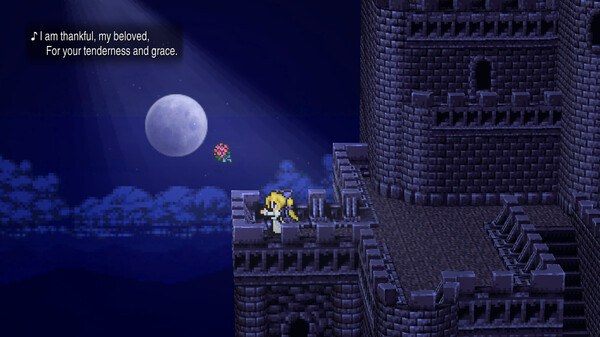
Celes takes the stage in Final Fantasy VI's opera
Final Fantasy VI’s opera episode turns a party member into a singer, a stage role into a practical disguise, and a performance into a risk that cannot be solved by pretending the danger is imaginary. Its mechanics make commitment the scene’s real test.
Coverage: Spoils the opera episode, including Celes’s performance and the threat to the production; no later story events.
Maria is a part Celes must play
At the opera house, Celes takes the stage as Maria, the heroine of the production. The distinction matters: Maria is the character represented in the opera, while Celes is the person asked to embody her. The scene’s charm depends on that theatrical doubling, but its tension depends on Celes not disappearing into the part. The audience sees Maria; the player knows Celes has entered the role for a reason beyond applause.
This is not a performance that can be treated as decorative downtime. The opera provides access to the place where the party needs to be, so Celes’s success as Maria is tied to the group’s immediate plan. That practical purpose gives her acting a weight the fictional audience does not share. They are watching a romance; the player is watching a character attempt to make that romance persuasive enough to carry a real operation.
The scene makes performance playable
The performance is not left entirely to animation or dialogue. The player has to choose responses in time with the operatic exchange, guiding Celes through the scene’s words and gestures. That interaction asks for attention to a form of communication unlike the game’s ordinary battles and navigation. The player is not selecting an attack or reading an enemy’s movement; they are helping maintain a public fiction whose rhythm is part of its credibility.
The mechanic also gives error a different texture. A missed cue is not simply a lower score detached from the scene. It threatens the impression that Maria is in command of her own part. Celes’s vulnerability comes from having to perform under observation, with the player sharing some responsibility for whether the act holds together. The episode makes theatrical confidence something enacted through timing, rather than a personality trait announced in advance.
A role offers cover and exposure
The stage gives Celes a kind of protection because it lets her appear as someone else. As Maria, she can enter a space in a way that would not be possible as an obvious member of the party. But the disguise also exposes her. She has to be seen, heard, and judged by an audience while trusting that the role will carry her through. The same visibility that enables the plan makes failure conspicuous.
The opera’s romance intensifies that double condition. Celes must convey a character’s longing without turning Maria’s feelings into a transparent statement of Celes’s own. It is tempting to read every line as confession, but the scene is more interesting when the two identities remain distinct. Celes’s task is to make Maria legible while retaining the private purpose that brought her onto the stage. Commitment means respecting the role’s demands, not claiming that the role tells us everything about the performer.
The stage cannot keep danger fictional
The opera episode eventually lets the practical danger behind the performance intrude upon the production. The contrast is the scene’s pivot: a stage can frame conflict as scripted, but it cannot guarantee that every threat will stay in the script. Celes’s performance and the party’s plan have to coexist with an event that presses beyond the theater’s conventions. The episode shifts from watching a role succeed to seeing how much that success can and cannot control.
That shift resolves the scene’s argument about commitment. Celes does not prove herself by forgetting she is Celes, nor by treating acting as a harmless mask. She accepts the work of sustaining Maria’s part while circumstances make the performance dangerous. The opera becomes more than an elaborate set piece because its mechanics, its disguise, and its interruption all ask the same question: will the characters act within a fiction when real consequences depend on it? Celes’s answer is a performance that remains a choice.
Primary work & further reading
Primary work: Final Fantasy VI. Character and story readings are editorial interpretations. The publisher reference below identifies the work and its premise.