Who controls Terra at the start of Final Fantasy VI?
A girl walks through a frozen town under machinery’s command, powerful enough to frighten the people around her and unable to explain herself. Final Fantasy VI makes that gap between force and self-knowledge its first dramatic problem.
Coverage: Covers the Magitek opening and early Narshe events only; no late-world or parentage revelations.
A body turned into a weapon
Final Fantasy VI begins with Terra moving through Narshe in a Magitek Armor, accompanied by soldiers and directed toward a target. The image makes her seem less like an adventurer setting out than a piece of military equipment in transit. Her power is visible before her agency is. The machine’s steps, the soldiers’ orders, and the attack on the mines establish a world where technology can make violence feel organized and impersonal.
Yet the opening gives Terra a complication that the armor cannot contain. She is not simply a pilot with a dangerous tool; her unexplained magic is the reason the Empire wants her and the reason people fear her. The contrast between metal and magic does not resolve into a clean opposition. Both can be used to dominate, and Terra is caught where those forms of power meet. The question is not merely what she can do, but whether any action she takes can belong to her.
Control becomes a problem of identity
The opening’s most important constraint is that Terra has little language for her own situation. She has been controlled, and the game does not initially offer a full account of how that control was imposed or what it has cost her. This limited understanding matters: the player encounters her uncertainty from inside the story’s gaps rather than receiving a settled biography before the adventure begins.
That uncertainty also makes the player’s ordinary role in an RPG feel newly charged. Giving commands to a character is usually a transparent convention. Here, the story has already shown that orders can be the means by which Terra’s body is put to work. The game does not claim that player input is equivalent to the Empire’s coercion, but the opening makes command harder to treat as neutral. Terra’s struggle to act for herself gives the basic act of directing a party a moral edge.
Narshe cannot make her power ordinary
When Terra is separated from the soldiers and reaches Narshe, the shift in surroundings does not produce instant safety. The townspeople see the threat that has entered their home, while the circumstances that brought her there remain unclear to her. Their fear is understandable, but it also risks reducing her to the power she cannot explain. A person who has been used as a weapon is now met as if the weapon were all there is.
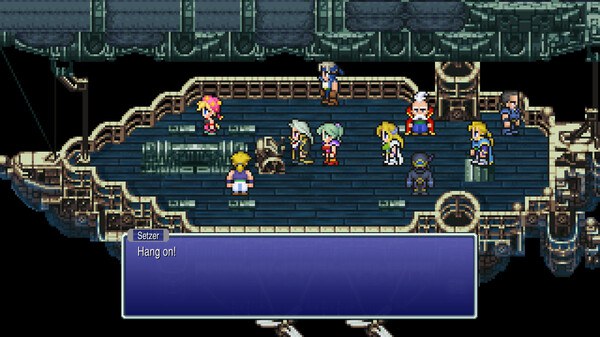
Locke’s intervention changes the immediate terms of the encounter by protecting Terra, but protection is not the same as an answer. She is no longer moving under the Empire’s direct command, yet she has not gained a settled understanding of herself. The escape gives her room to make choices while keeping the central question open. That distinction stops rescue from functioning as a simple cure: freedom begins as a condition she must learn how to inhabit.
The opening keeps its question alive
The Magitek march therefore serves as more than a spectacular introduction to the game’s machines and magic. It presents a person whose abilities precede her sense of identity and whose apparent strength conceals a lack of control. Later events in the opening stretch the meaning of that conflict without making Terra’s inner life easy to summarize. She has to meet other people as someone who can be feared, useful, vulnerable, and still unknown to herself.
That is why Terra’s uncertainty gives Final Fantasy VI its opening question. The story does not ask only whether she can escape the people directing her. It asks what freedom means when the very power that makes her valuable has been treated as public property. The answer cannot arrive as a new weapon or a change of uniform. It begins when Terra is allowed to move through the world as a person whose choices remain unfinished, and therefore still her own.
Primary work & further reading
Primary work: Final Fantasy VI. Character and story readings are editorial interpretations. The publisher reference below identifies the work and its premise.