Stormveil Castle makes a shortcut feel earned
Stormveil’s gates, side passages, and stacked spaces turn navigation into a record of decisions. Its shortcuts feel satisfying because the castle first makes distance, exposure, and backtracking tangible.
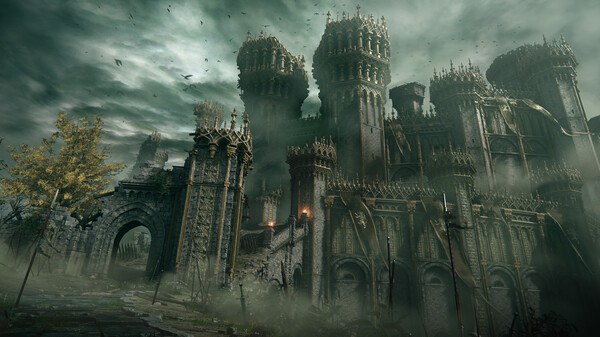
Coverage: Early Stormveil Castle layout and navigation, including its gate, side path, vertical spaces, and shortcuts; no late lore revelations.
The front gate makes the obvious route costly
Stormveil Castle gives its entrance the weight of a decision. The front gate is a conspicuous way in, but the dangers around it make directness feel expensive. The player can seek another route rather than treating the most visible opening as the intended answer. That choice establishes the castle’s central navigational tension: the shortest-looking line and the safest-feeling line are not always the same. Before the player has understood the whole fortress, its entrance already asks how much risk a straight approach is worth.
The side path changes the question without making danger disappear. It offers a way around the immediate pressure of the gate, but it leads into a castle whose spaces remain hostile and interconnected. Choosing it is not a simple bypass of the level’s challenge; it is a change in the form that challenge takes. A guarded threshold might be replaced by narrow passages, awkward approaches, and uncertainty about what waits beyond a turn. The route feels like a personal decision because the game lets the player accept its trade-offs rather than presenting one universal solution.
Vertical space turns orientation into work
Inside, Stormveil’s stacked architecture makes height part of the player’s map. Stairs, ledges, rooms, and elevated walks reshape the view of places already crossed. A doorway may be easy to notice from above but inaccessible from below, while a drop can connect spaces in a way that is not obvious until the player has explored both sides. The castle therefore asks for more than memorizing a sequence of rooms. The player learns how spaces relate, including where sightlines promise a connection that movement has not yet made available.
That verticality also changes the emotional texture of danger. A threat above can make a familiar corridor feel exposed; a route down can raise the question of whether there is a way back. Stormveil’s layout encourages attention to edges, stairs, and openings because these details affect both combat and navigation. The player is not merely moving through decorated scenery. Architecture can determine whether a fight is approached head-on, encountered from a different level, or avoided while searching for another connection.
Repeated ground accumulates meaning
A shortcut in Stormveil feels earned because the player has already paid attention to the distance it removes. Before a route becomes familiar, crossing the castle takes care: each doorway can conceal another threat, and each junction creates the possibility of losing direction. Returning through a known stretch is not the same experience as entering it for the first time. The player recognizes landmarks, remembers pressures, and can judge which part of the journey is genuinely new. Repetition turns space into knowledge.
When a shortcut links areas that once felt separate, its value is practical and emotional. It cuts down on travel, but it also confirms that the player has made a coherent map from a place that initially resisted one. That recognition is why an opened connection can feel more satisfying than a newly discovered room. It changes the meaning of rooms already visited. The castle becomes less like a succession of isolated ordeals and more like a structure the player has learned to navigate on its own terms.
The shortcut records an act of understanding
Stormveil’s routes support a form of progress that cannot be measured only by which enemies have fallen. The player may advance by recognizing a safer approach, finding a link between levels, or learning where a familiar passage leads. These gains are easy to overlook if the castle is treated solely as a set of fights. Yet the layout makes navigation a meaningful achievement because it asks the player to transform uncertainty into usable knowledge. Opening a shortcut makes that transformation visible.
The result is a dungeon where a return trip can feel like evidence of mastery rather than repetition. The gate teaches that apparent directness may carry a cost; the side path makes alternatives consequential; the vertical spaces reward looking beyond the current floor. Together, they give shortcuts their force. The player has not merely found a convenient door. They have learned enough about Stormveil to make the fortress answer a different question than it did at the entrance: not how to get through once, but how its spaces fit together.
Primary work & further reading
Primary work: Elden Ring. Character and story readings are editorial interpretations. The publisher reference below identifies the work and its premise.