Dragon Quest XI's towns reward walking slowly
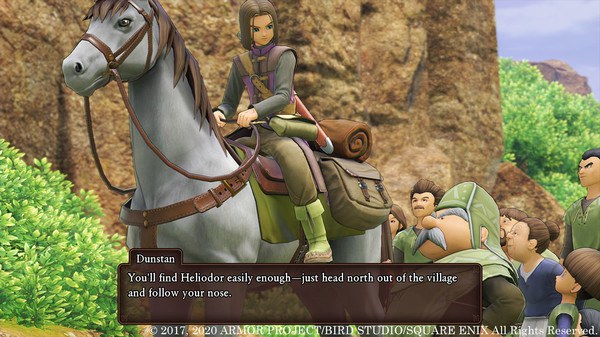
Dragon Quest XI’s early towns make exploration feel like a way of reading a place. Their streets, routines and passing conversations add local meaning between major objectives, giving the journey texture at walking pace.
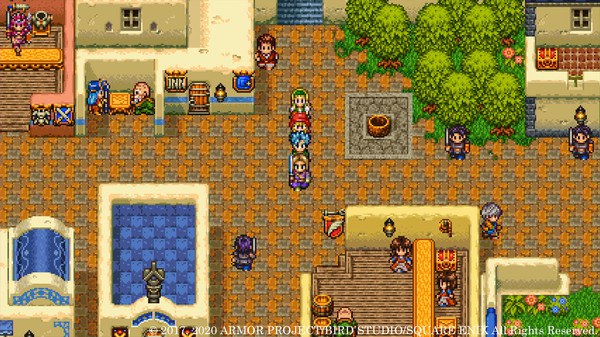
Coverage: Discusses exploration and everyday town details in early Cobblestone and Heliodor; no later world-state developments or secret-reward claims.
A town is more than a marker on the route
Dragon Quest XI’s towns invite the player to treat arrival as more than a pause between battles. Cobblestone has the scale of a village whose relationships are already familiar: the coming-of-age ceremony, the protagonist’s connection to Gemma and the communal setting make the place feel inhabited before the main journey begins. The town matters as a home with its own social rhythm, not simply as the first label on a map. Walking through it gives the opening room to establish what the hero stands to leave behind.
Heliodor changes that feeling through scale and authority. As the capital, it places the protagonist within a more formal environment, where the king’s judgment can reach beyond a single conversation and shape his immediate safety. The contrast between the village and the city is not just a difference in architecture or population. It is a difference in how a person is situated among others: known through everyday ties in Cobblestone, exposed to institutions in Heliodor. Moving at street level lets the shift register as lived experience.
Local talk gives a place its own point of view
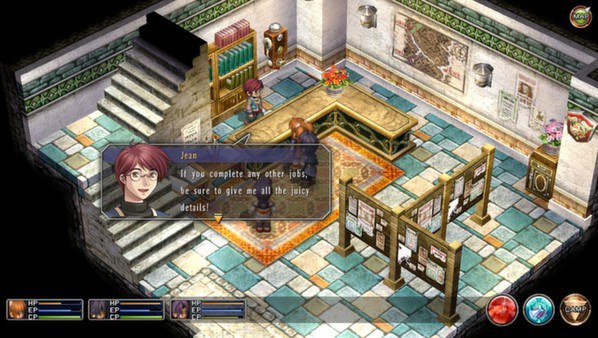
NPC dialogue helps make these locations feel like communities rather than containers for the hero’s next instruction. Even when a conversation does not redirect the main quest, it can reveal that the inhabitants have concerns and expectations beyond the protagonist’s purpose. That matters especially in a game whose central character carries a legendary identity. The townspeople’s ordinary presence prevents the world from shrinking into a set of reactions to the Luminary alone. A place gains texture when its residents appear to have their own lives.
The opening also shows why the same identity can be received differently from one setting to another. Cobblestone’s relationship to the hero begins in familiarity and communal ceremony, while Heliodor’s king interprets the revealed identity as a threat. This is a large narrative difference, but it becomes easier to grasp when encountered in the context of each town’s social structure. The village offers close personal bonds; the capital offers the authority to classify and pursue. Listening to people in a town helps the player sense the distance between those kinds of power.
Walking turns scenery into context
The game’s detailed environments reward looking around because visual detail can give social meaning to a space. A village and a capital need not tell their stories through the same arrangement of buildings, streets or public spaces. The player can read differences in scale and use simply by moving through them at human pace. The environment becomes a companion to dialogue: one shows the shape of the community, the other lets its people speak from within it. Neither needs to announce a hidden prize to justify attention.
This slower movement also changes the rhythm of adventure. A quest objective points toward the next necessary action; walking through town permits a less urgent kind of attention. The player may notice a familiar route, a public space or the way the settlement frames a meeting with authority. Such details are not all clues, and they do not have to be. Their value is cumulative: they make the world feel as though it exists beyond the moment when the hero needs something from it. Exploration becomes a form of understanding rather than a hunt for guaranteed rewards.
The pause between quests is part of the story
Dragon Quest XI’s early towns establish emotional context that the road alone cannot provide. Cobblestone gives the protagonist a home life against which departure has meaning. Heliodor gives his identity a political consequence by placing him before the king and showing how quickly a public judgment can become pursuit. These scenes make the settlements more than service stops. Their differences shape how the player understands the journey’s stakes, even before the world opens farther.
Walking slowly is therefore a way to notice what the main objective cannot carry by itself. A quest can state where the hero must go, but a town shows who lives around that direction and how the protagonist’s presence changes the space. The best reward is not a promised item tucked behind every conversation. It is a clearer sense of why places feel different and why leaving one for another matters. By giving attention to streets, local voices and social scale, the player reads the journey as a passage through communities, not just a line between destinations.
Primary work & further reading
Primary work: Dragon Quest XI. Character and story readings are editorial interpretations. The publisher reference below identifies the work and its premise.