Being the Luminary is not enough to be believed
Dragon Quest XI makes a sacred identity feel surprisingly ordinary: the hero can carry a mark of destiny and still meet suspicion at home and hostility in Heliodor. Those early responses give belief a human cost.

Coverage: Covers the coming-of-age journey through the hero’s early reception in Cobblestone and Heliodor; no later world-state revelations.
A sign of destiny enters an ordinary village
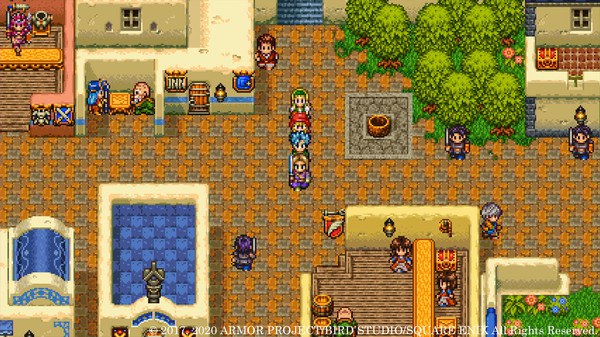
Dragon Quest XI begins its argument about belief in a place where the hero is already known. Cobblestone is not waiting for a stranger to arrive and announce a grand identity; it is a village of familiar faces, routines and expectations. The protagonist’s coming-of-age ceremony gives the journey a social beginning. His trip to the sacred stone with Gemma belongs first to the recognizable life of a young villager, even as the mark on his hand points toward a larger story. That contrast makes the sign meaningful without making it self-explanatory.
The village can accept the hero because its people have reasons to care about him before destiny becomes the subject. Gemma’s companionship and the ceremony’s communal setting establish bonds that do not depend on proving the Luminary’s legend. Their confidence offers a kind of belief grounded in shared history: they know this young man, even if they do not yet know what his mark means. The story therefore separates personal trust from public recognition. One can be loved as oneself before being understood as a symbol.
The journey turns recognition into a test
The road from Cobblestone to Heliodor changes the conditions under which the hero is seen. At home, the coming-of-age ritual frames his discovery as part of a community’s passage into adulthood. In the capital, the same identity is brought before an authority with power to define its meaning. The hero’s revelation to the king should seem like the moment when private evidence meets public knowledge. Instead, the response turns the expected recognition upside down: the Luminary is branded as “The Darkspawn” and pursued.
This reversal makes the title of Luminary insufficient in a precise way. It may identify the hero within the world’s history, but it does not dictate what a ruler will believe about him. Heliodor has institutions, guards and a court capable of acting on the king’s judgment; the protagonist has a name and a sign, neither of which can compel a fair hearing. The result is not simply an individual misunderstanding. It shows how an identity can be made dangerous when authority interprets it as a threat. The hero’s sacred role arrives as a claim others can refuse.
Cobblestone’s faith has limits, and that matters
The warmth of Cobblestone does not erase the danger that follows. The village’s connection to the hero provides emotional grounding, but it cannot make the king’s decision disappear or place the protagonist beyond the reach of Heliodor’s army. That distinction keeps the opening from treating home as a magical guarantee. Familiarity can make a person legible to neighbors; it cannot automatically change how distant power reads the same person.
The contrast also prevents the hero’s identity from flattening everyone around him into witnesses to his destiny. Gemma is present as a childhood friend, and the village has its own communal life. Their relationship to the protagonist begins in affection and shared experience, not a formal ceremony of allegiance. That small difference lends the opening its emotional scale. The Luminary may matter to the world, but the people closest to him meet a young man whose life they have seen unfold. Their response feels immediate because it is rooted in the ordinary.
Belief becomes something the journey must earn
Once Heliodor rejects the hero, the story cannot rely on a single revelation to gather companions. The premise describes him assembling adventurers who believe he is the Luminary reborn, which shifts belief from a verdict handed down by a throne to a relationship formed along the road. This is not the same as saying that trust is easy or that every person will see the mark and understand it. The early rejection has already established that evidence does not interpret itself. What matters is how people encounter the person carrying it.
That makes the opening’s central tension more interesting than a simple dispute over whether the legend is true. The hero’s identity may be real within the story, but its social force depends on who is willing to recognize it and what they do with that recognition. Cobblestone offers the intimacy of being known; Heliodor exposes the violence of being defined from above. Between them, Dragon Quest XI makes belief a human act with consequences. The Luminary’s name can start the journey, but it cannot walk the road or persuade anyone by itself.
Primary work & further reading
Primary work: Dragon Quest XI. Character and story readings are editorial interpretations. The publisher reference below identifies the work and its premise.