Erik is a useful person to meet in prison
The prison meeting with Erik makes companionship feel less like a prophecy and more like a useful arrangement. His streetwise skills give the hero a way forward, while their shared danger begins a quieter form of trust.
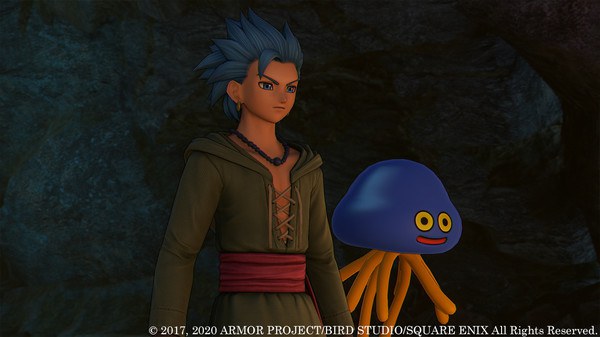
Coverage: Covers Erik’s prison meeting with the hero, their escape and early cooperation; no resolution of Erik’s family history.
A cell changes the shape of a first meeting
Erik does not enter Dragon Quest XI as a polished answer to the hero’s isolation. Their meeting happens in prison, a place that compresses choice and makes immediate needs impossible to ignore. The hero arrives carrying an identity that has already brought him into conflict with Heliodor’s king. Erik, by contrast, is introduced through the practical fact of confinement. Neither man can simply step away from the other and resume an independent plan. That forced proximity gives their first cooperation a believable scale.
The setting also changes what counts as a promising companion. A ceremonial ally might affirm the hero’s destiny or offer a speech about the road ahead. Erik can offer something more immediate: he understands how to get through a dangerous situation. Their partnership starts in the gap between what the hero represents and what the pair actually need. The prison does not make them friends by decree. It creates a problem that requires two people to pay attention to one another.
A thief’s skills turn into a form of care
Erik’s identity as a thief matters because it shapes how he helps. He is alert to openings, obstacles and the practical arrangement of a situation. The story gives his usefulness a grounded texture: he knows how to act when official structures have made a person powerless. In the prison, that knowledge is more valuable than the hero’s status. A mark of destiny cannot open a cell or explain an escape route; a capable ally can help turn a trapped pair into moving people again.
There is care in this kind of competence, even if it does not look sentimental. Erik’s attention to what can be done keeps the hero’s danger from remaining abstract. He helps because the immediate circumstances demand action, and his experience gives him a way to respond. That makes his thief skills more than a bundle of adventure-game utility. They are the language through which he first contributes to the relationship. He does not need to understand every meaning of the Luminary to recognize that the person beside him needs help getting out.
Mutual dependence keeps the partnership human
The escape does not reduce Erik to a tool for the protagonist. His own presence, judgment and willingness to cooperate matter, while the hero becomes someone he can move alongside rather than merely a problem to solve. Mutual dependence is not identical to equal power in every moment; the two men bring different kinds of strength. The hero has the burden of a public identity and the danger attached to it. Erik has the streetwise competence that makes the next step possible. Their needs overlap without becoming interchangeable.
That balance is important for a story built around a legendary figure. If every ally simply arrived to applaud the Luminary, the hero’s journey would risk feeling like a parade of confirmations. Erik’s entry offers a more grounded model. A companion can join because a shared situation gives cooperation value before the grand meaning of the quest is settled. The friendship has room to develop because it begins with an action and an exchange, not a completed emotional promise. They have helped one another survive the present; that is enough to make the next stretch of road plausible.
An ally is someone who changes what is possible
Erik’s practical nature makes the hero’s new alliance legible through consequences. Together, the pair can confront circumstances that would keep either one alone at a disadvantage. The story need not make Erik’s skill look grand to make it matter. His attention to real constraints—where they are, what threatens them and what action could free them—adds a second intelligence to the hero’s journey. The protagonist’s role may point toward a larger fate, but Erik helps keep the scene moving in the world immediately around them.
That is why Erik’s early contribution feels like more than a convenient introduction to a party member. He gives the hero a practical ally at the point when the hero’s symbolic identity has failed to secure practical protection. The contrast is sharp: the king’s label isolates the Luminary, while a thief’s competence creates a route out. Their connection starts because each can make a difference to the other. In Dragon Quest XI, that kind of dependence is a convincing beginning for trust: not instant devotion, but the discovery that someone else’s way of seeing the problem can make a future possible.
Primary work & further reading
Primary work: Dragon Quest XI. Character and story readings are editorial interpretations. The publisher reference below identifies the work and its premise.