Neo-Tokyo is still under construction in Akira
In the opening volume of Katsuhiro Otomo’s manga, construction crowds the city even as unrest travels through it. Neo-Tokyo’s unfinished surfaces make recovery feel less like a settled achievement than a fragile, contested project.
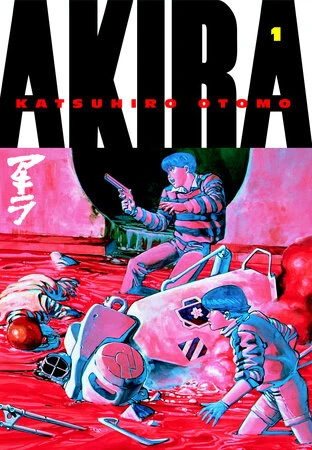
Coverage: Opening volume only; covers Neo-Tokyo’s post-disaster setting, youth gangs, construction and institutions without later destruction spoilers.
A city rebuilt on unsettled ground
Neo-Tokyo announces itself through a contradiction: it is a rebuilt city, but it does not look finished with rebuilding. Vast structures rise above roads and neighborhoods where ordinary life continues, while construction sites and exposed frameworks keep the work of recovery in view. The setting carries the memory of catastrophe without turning every page into a memorial. Instead, the physical scale of the city makes the past feel embedded in its present tense. Rebuilding is not a clean border between then and now; it is an ongoing condition.
That unfinished quality changes the meaning of the skyline. A tower or elevated roadway can suggest ambition, but its presence also hints at how much has been rearranged to make the city function again. Otomo’s detailed backgrounds give the built environment weight: it occupies space that characters must cross, look up at, and move around. The city’s impressive size is therefore not just a sign of progress. It makes human security appear provisional, as if order depends on structures whose full social consequences have yet to be settled.
Construction does not quiet the streets
The motorcycle gangs belong to this urban landscape rather than hovering outside it as a separate youth problem. Their routes cut through a city shaped by roads, open stretches, barriers, and crowded districts. Movement itself becomes a claim on public space. The riders turn infrastructure built for circulation into a stage for rivalry and display, making the promise of an orderly city collide with the noisy freedom of its young people.
This collision keeps the setting from becoming a simple picture of chaos. Gang members have their own loyalties and hierarchies; they are not an undifferentiated crowd. Yet their social world unfolds against streets that also carry commuters, institutions, and the routines of a much larger population. The city is shared, though not peacefully or on equal terms. Every ride can look like a brief takeover of a public route, one that reveals how thin the boundary is between everyday mobility and a challenge to authority.
Institutions are present but not reassuring
The opening volume brings formal power into the same unstable setting. Police and military authorities operate amid the unrest, and the story’s attention to government and research institutions broadens the question of who is allowed to control the city. Their presence promises a response to danger, but it also introduces forms of power that are harder for ordinary residents to see or contest. Institutional order does not simply replace street disorder; it develops alongside it, using its own spaces, procedures, and force.
That parallel matters because Neo-Tokyo is not presented as a city where a single authority can explain every disturbance. The gangs are visible, legible to the public, and easy to treat as a problem of youth. State institutions, by contrast, possess a reach that is less exposed to ordinary street life. Otomo places both kinds of power in the same urban frame without suggesting they are equivalent. The contrast makes the city’s stability a question of accountability as well as safety: who can act, who can see what is happening, and who bears the consequences?
Recovery looks like a continuing argument
The opening’s cityscape makes rebuilding tangible, but it refuses to treat new construction as proof that the underlying crisis has ended. The routes and buildings offer a working urban world; the conflicts moving through them show how unevenly that world is held together. Youth culture, public order, and official power all press against the same limited space. The city’s scale makes those pressures feel systemic, while the detail of streets and structures keeps them connected to daily life.
Neo-Tokyo consequently reads less as a finished monument to recovery than as an argument about what recovery can mean. Physical reconstruction may provide roads, buildings, and institutions, but it cannot automatically settle social distrust or make authority benign. The city remains compelling because it is functioning and vulnerable at once. Its rebuilt surfaces do not erase instability; they give instability somewhere to gather, travel, and become visible.
Primary work & further reading
Primary work: Akira. Character and story readings are editorial interpretations. The publisher reference below identifies the work and its premise.