Linus changes the meaning of being a neighbor
Linus lives outside the town’s domestic routines, yet his place in Stardew Valley is not defined by absence or need. Friendship with him invites the farmer to reconsider what neighborliness looks like when someone chooses a different way of living.
Coverage: Covers Linus’s outdoor life, his early position in the valley, and the development of friendship at a general level.
A neighbor at the edge of town
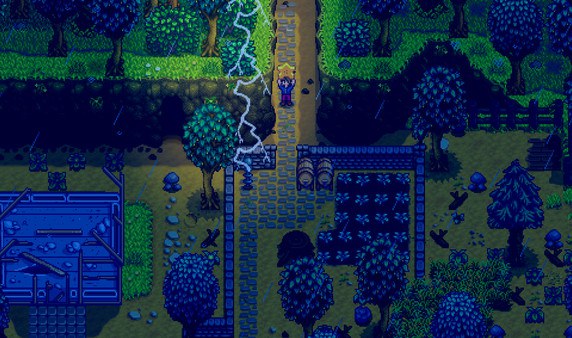
Linus is introduced through geography as much as conversation. He lives outdoors, apart from the houses and shops that organize the town’s everyday life. That position can make him look like a problem waiting for the player’s solution: a lonely person at the margins who must be brought into conventional comfort. Stardew Valley complicates that first impression. Linus is part of the valley’s social world, even if his home and habits do not match the town’s domestic pattern.
The game’s early placement of Linus matters. A new farmer is also an outsider, learning the valley by walking through it rather than belonging to it immediately. Linus occupies a more settled version of that distance. He knows the place, but does not live at its center. Their encounters can therefore feel like a meeting between two kinds of newcomer: one building a home on inherited land, another maintaining a life beyond the town’s usual boundaries. His presence asks the player to notice who counts as a neighbor even when they are not encountered through ordinary civic routines.
Outdoor life as a choice of terms
Linus’s outdoor life is not merely a visual shorthand for hardship. It changes the terms on which the player might approach him. The farmer’s own project is to cultivate land, build structures, and turn a rough plot into a home. Linus stands apart from that model. His way of living makes the game’s language of improvement less universal: a person’s worth cannot be measured by how closely their circumstances resemble the player’s farm, house, or schedule.
This contrast also gives friendship a more interesting purpose. The player does not need to convert Linus into a reflection of their own life before a relationship can matter. Showing up, speaking with him, and learning about him are meaningful actions in their own right. Stardew Valley’s friendship system can sometimes feel like a ladder of rewards, but Linus resists being reduced to a locked set of benefits. He is a character whose place in the world remains distinct as the player becomes more familiar with him.
The town’s assumptions come into view
Because Linus lives apart from conventional homes, the way other people regard him becomes part of his characterization. The valley’s social norms are usually presented through ordinary routines: where people go, who they see, and which places feel welcoming. Linus exposes the limits of that arrangement. A community can recognize someone as present while still treating their difference as a reason for suspicion or distance. The player’s encounters with him make that tension visible without requiring a grand speech about belonging.
The point is not that the town is uniformly cruel or that Linus needs rescuing from it. Rather, his position reveals how easily comfort can become the standard by which everyone else is judged. The farmer may have tools, a house, and an expanding plot, but those forms of security do not confer authority over another person’s choices. Linus’s character shifts attention from the question of how to improve his life to the more basic question of how to meet him with respect.
Friendship without a makeover
Friendship with Linus is compelling because it does not have to culminate in a change of address or lifestyle. As the player gets to know him, the relationship adds understanding without erasing the difference that made him noticeable in the first place. The game treats recognition as an outcome, not merely a step toward a more conventional ending. That choice makes the friendship feel reciprocal: the farmer gains a fuller sense of Linus, while Linus remains the author of his own daily life.
Linus therefore broadens Stardew Valley’s idea of community. A neighbor need not share the player’s work, housing, or ambitions to belong in the valley’s moral landscape. His outdoor life can be unfamiliar and still be treated as a life, not a deficit in need of correction. By letting friendship deepen without turning him into a project, the game offers a quieter form of inclusion: pay attention, make room for difference, and accept that closeness does not require possession or control.
Primary work & further reading
Primary work: Stardew Valley. Character and story readings are editorial interpretations. The publisher reference below identifies the work and its premise.