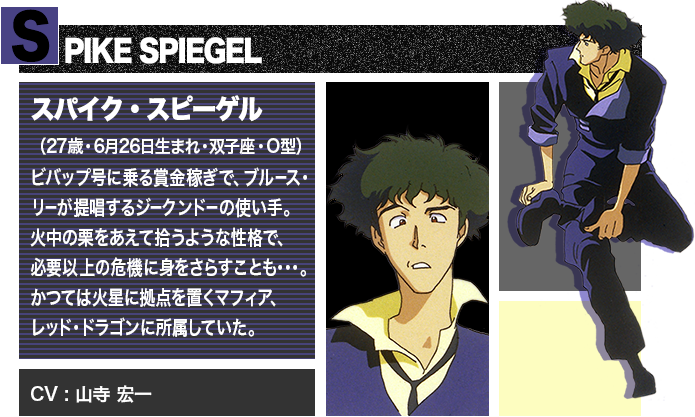
Spike Spiegel looks relaxed. His world rarely is.
Spike Spiegel’s comic ease can make him look untouched by danger. In the early episodes, his relaxed posture and improvised fighting instead suggest someone who has learned to treat risk as ordinary, even as the show keeps exposing its cost.
Coverage: Covers Spike’s characterization and fighting style in early episodes only; excludes the Julia and Vicious resolutions and finale events.
A slouch that invites trouble
Spike Spiegel enters the series with the air of a man who has nowhere urgent to be. He lounges, drifts into conversations, and meets danger with a shrug that can read as comic indifference. The looseness is part of the show’s rhythm: a bounty hunter may spend as much time waiting, bickering, or failing to collect as he does pursuing anyone. Spike seems perfectly suited to that disorder, but his ease also makes the danger around him look deceptively small.
That impression changes when the action begins. Spike does not become solemn so much as precise. He can move from languid stillness to a sudden, tightly directed burst of motion, as though his body has been saving its attention for the moment it matters. The contrast makes his casualness feel practiced. He is not unaware of risk; he has made room for it in his ordinary life. His posture says that trouble is familiar enough not to merit alarm.
Fighting as improvisation
The series’ Jeet Kune Do influence is legible in the way Spike fights: movement adapts to the immediate opponent rather than unfolding as a rigid display of technique. He uses what the moment gives him, changing direction, closing distance, or making a narrow opening count. The style feels less like a polished performance than a response under pressure. That quality connects the physical comedy of his everyday behavior to the action. Spike’s apparent carelessness is also a capacity to react when circumstances refuse to follow a plan.
Improvisation does not make him invulnerable. It makes him difficult to read, and that uncertainty is useful in a fight, but the body still takes hits and the outcome is never guaranteed. The animation lets a dodge or counter feel exhilarating without turning combat into a frictionless game. Spike’s grace therefore carries a quiet cost: surviving by adaptation means accepting that the situation may already have gone wrong. His skill is not control over every encounter; it is an ability to find a move inside disorder.
The joke and the danger share a face
Spike’s humor helps preserve that instability. He can seem unserious at exactly the point where a conventional action hero would announce his resolve. The joke may ease the tension for a beat, but it does not erase the threat. Instead, humor becomes another way he declines to give danger the ceremony it demands. A bounty can be absurd, a plan can collapse, and Spike can still appear mildly amused. This is funny, but it also hints at a life in which crisis has become too common to treat as exceptional.
The early episodic structure reinforces the impression by repeatedly placing Spike in situations that do not build neatly toward triumph. The job may be strange, the pursuit frustrating, and the reward uncertain. He returns to the Bebop with no heroic glow that makes the next problem seem smaller. The routine wears down the distinction between adventure and work. Spike’s relaxed manner fits a world where danger arrives often, while satisfaction arrives less reliably.
Borrowed time in the present tense
A viewer can read Spike’s casualness as a way of living without making long plans. The series does not need to explain that impulse in order to make it visible: he gives the present moment his attention, then moves on when it passes. His physical skill makes this look like freedom. Yet the same pattern leaves him exposed to whatever comes next. If one trusts reflexes more than stability, each narrow escape can feel like proof that the method works, even while it postpones any reckoning with its limits.
That tension is what keeps Spike from becoming a simple cool-headed fighter. His looseness is attractive because it refuses panic, but it also suggests a person who has made danger familiar by living close to it. The Jeet Kune Do inflection gives that attitude a physical vocabulary: adapt, strike, keep moving. In the early episodes, his ease is less a sign that nothing can touch him than a way of spending time as though there were always another moment to meet. The show lets that confidence entertain us while leaving its fragility in view.
Primary work & further reading
Primary work: Cowboy Bebop. Character and story readings are editorial interpretations. The publisher reference below identifies the work and its premise.