Alice gives Lain's digital mystery a human scale
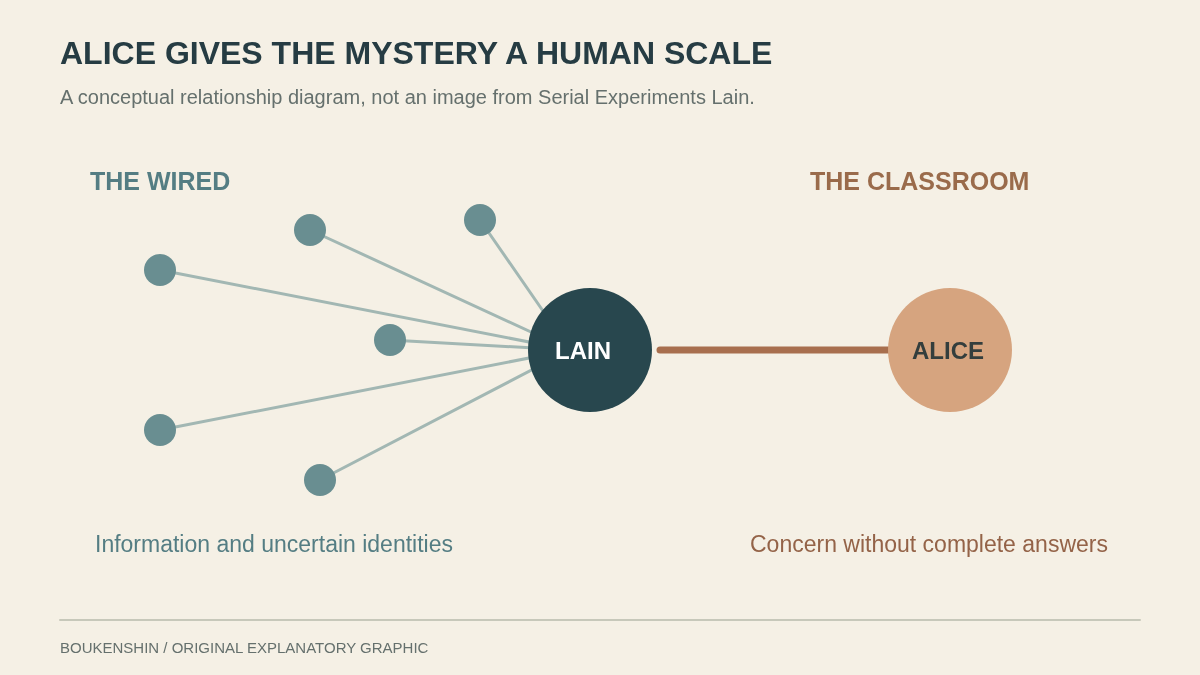
Before the Wired becomes an overwhelming question, Alice meets Lain as a classmate who may need a friend. Her concern grounds the series’ strange communications in the small risks and uncertainties of ordinary friendship.
Coverage: Early school episodes only; covers Alice’s friendship and concern for Lain without later trauma or final resolution.
A friend who notices the quiet
Alice matters because she responds to Lain as a person before the series asks the viewer to treat her as a mystery. At school, Lain is withdrawn and difficult to read. Her reserve could make her fade into the background of other students’ conversations, but Alice does not simply accept that distance as proof there is nothing to know. She makes room for contact, giving Lain a social possibility that the Wired cannot provide in the same way: a relationship with someone present in the same classroom.
That attention is not a grand gesture. Its modest scale is what makes it useful. Alice’s concern arrives through the familiar rhythms of classmates interacting, where a question or an invitation can matter without solving anything. Lain is not suddenly transformed into an outgoing girl, and Alice cannot make the uncertainty around her disappear. Instead, their friendship gives the viewer a human measure for change. When Lain behaves differently, there is someone nearby whose reaction helps show that the difference has consequences in ordinary life.
Care without full understanding
Alice’s role is especially effective because friendship does not give her complete access to Lain’s inner life. She can notice that something seems off and try to respond, but she cannot automatically interpret what is happening. That limitation keeps concern from becoming exposition. Alice is not a guide who translates the Wired into a set of answers; she is a friend negotiating the same uncertainty the viewer faces, with the added difficulty that she cares about the person at its center.
This gap between noticing and knowing makes Alice’s kindness feel grounded. In a story where messages and identities can become hard to place, a friend’s attention may still be direct without being all-knowing. Alice’s concern says, in effect, that Lain’s changes are worth responding to even if their cause cannot yet be named. The series thereby gives human care a form distinct from information. A message can carry data; a friendship involves an attempt to remain attentive when certainty is unavailable.
School keeps the stakes ordinary
The school setting puts a useful limit on the scale of Lain’s digital questions. Alice encounters her amid classmate relationships and everyday social expectations, not in a separate realm devoted to technology. Their connection therefore keeps Lain’s experience attached to the pressures of being seen, misunderstood, or left out. The supernatural or technological strangeness surrounding Lain may broaden the show’s horizon, but Alice’s presence continually returns attention to whether the girl beside her is all right.
This return to ordinary life also makes Alice’s concern vulnerable. Friendship cannot control what happens to Lain, and school is not a secure explanation for the events that unsettle her. Yet the setting gives their interactions a recognizable scale: a friend may worry, hesitate, or try to bridge an awkward silence. These small responses are important precisely because they do not compete with the show’s larger mysteries. They show what those mysteries can mean to someone who knows Lain socially, not just to an audience watching an enigmatic protagonist.
The friendship’s value is its incompleteness
Alice gives Lain’s story a human scale without turning friendship into a cure. That distinction protects both characters. Lain remains difficult to understand, and Alice remains a concerned classmate rather than an all-purpose rescuer. Their bond can matter even while it is uncertain and limited. In fact, its limitations make the relationship more persuasive: a friend can offer presence, but cannot guarantee that presence will be enough.
The series’ digital mystery grows more affecting when measured against this ordinary connection. Lain is not only someone encountering strange communications; she is also a student with a friend who pays attention. Alice’s concern makes the stakes legible without explaining away the unknown. It gives the viewer a reason to care about what Lain’s isolation costs, while preserving the uneasy space between what a friend can sense and what she can know.
Primary work & further reading
Primary work: Serial Experiments Lain. Character and story readings are editorial interpretations. The publisher reference below identifies the work and its premise.