OCTOPATH TRAVELER II’s day and night actions make towns into route choices
A spoiler-light practical guide to using the two daily Path Actions as a town-by-town planning tool: decide what to learn, acquire, recruit or open before moving on.
Coverage: Spoiler-light: explains the Path Action system and character examples without story revelations.
Treat the clock as a change of options
OCTOPATH TRAVELER II gives each traveler two Path Actions, one for daytime and one for night. Square Enix describes these as ways to interact with townspeople, obtain information or items, and bring people along. Because towns and available actions change with the day/night cycle, a settlement is not a single checklist that you clear once and forget. [1]
A useful first question is not “Which action is strongest?” but “What do I need from this town right now?” If a route is blocked, look for an action that changes access. If you are short on information, use an action that investigates. If you need a battle helper, consider recruiting. The clock lets the player choose which kind of interaction to attempt first.
Match actions to the problem you are trying to solve
Square Enix’s examples show how different the actions can be. Hikari can challenge a resident by day and potentially learn a skill, while at night he can bribe someone for hidden items or information. Throné can attempt to steal items in daylight and use Ambush at night, if her level is sufficient, to move past a blocking person. Osvald can scrutinize by day and mug at night, with the latter requiring a battle. [1] [2]
These are not interchangeable versions of the same button. A duel or mug can turn into combat; a theft can carry a probability of failure; bribery or purchase depends on money; and an ambush can depend on character level. Before acting, read the prompt and its stated condition. The right action is the one whose cost and risk fit the immediate goal.
Build a small town routine instead of sampling randomly
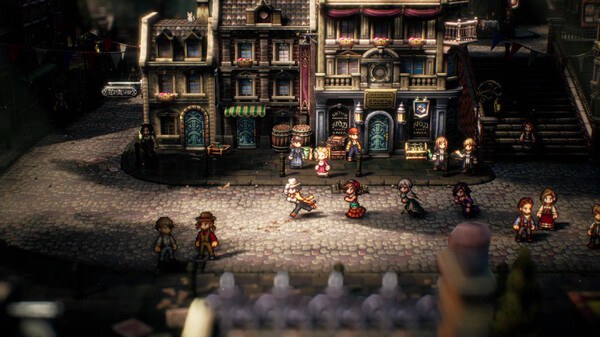
A repeatable routine helps when arriving in a new settlement. First inspect the map and identify blocked routes, notable residents and any visible item or information leads. Next, choose the traveler whose action can address the most useful lead. If it is daytime, handle that opportunity before switching the clock; then revisit the same area at night to see whether another action or resident interaction is available. [1]
For example, suppose a doorway is blocked and you also want to learn what a resident knows. You might use a nighttime Ambush with Throné to clear the passage, then return later with Osvald to scrutinize another resident. That is not a required sequence or a guaranteed solution for every town; it is a way to keep access and information as separate objectives, so one failed action does not obscure the other.
Notice the reputation and resource costs
Several actions have consequences. Square Enix’s traveler guide notes that failed attempts with some actions can damage reputation, after which Path Actions may become unavailable until reputation is repaired. Other actions require money or items, and some require you to win a fight. That means repeated attempts are not always free experimentation. [2]
Before choosing an uncertain action, check whether the game displays a success chance, a level requirement, a price or an item requirement. If the odds look poor, switch to an action with a different condition or return after gaining levels and resources. This is especially useful early in a chapter, when the party’s options may be narrow. The goal is to protect flexibility across the whole town visit, not to force one character to solve every obstacle.
Let the party’s needs set the order
Path Actions reward a short planning pause. If you are trying to expand combat options, Hikari’s daytime challenge can be more relevant than a purchase. If you want a helper, a character whose action recruits someone may be the better stop. If the obstacle is physical access, an action that moves a person out of the way is more direct than gathering unrelated information. The official overview frames these actions as one part of the game’s exploration and discovery, alongside its day/night world. [1]
A practical checklist is: identify the town problem, inspect the action’s condition, account for its cost or failure risk, and revisit after the clock changes if there is still a useful lead. This turns the cycle into an intentional route through the town. You are not trying to exhaust every interaction immediately; you are choosing which information, resource or access point will make the next leg of the journey easier.
Primary work & further reading
Primary work: OCTOPATH TRAVELER II. Character and story readings are editorial interpretations. The publisher reference below identifies the work and its premise.