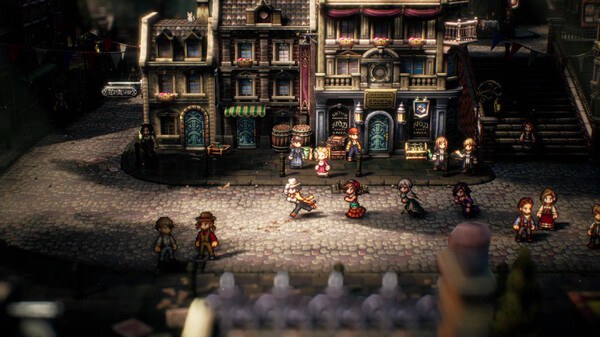
Temenos is a cleric who keeps asking questions
Temenos’s clerical office and inquisitive temperament pull in different directions only at first. His opening chapter treats questioning as a way to serve the truth when certainty would be easier to perform than to earn.

Coverage: Covers Temenos’s opening chapter and its early mystery, without revealing the culprit or final revelation.
A cleric with an investigator’s habits
Temenos occupies a role associated with faith, yet his opening chapter foregrounds how readily he questions what he is told. The contrast is not simply a joke about an irreverent cleric. It gives his duty a distinctive shape: he is willing to examine claims and follow uncertainty instead of treating authority as a substitute for evidence. His religious position makes the questions consequential because he is not standing outside the institution he serves.
His inquisitive manner also gives the early mystery a human point of view. Temenos is not presented as a neutral camera recording events. He actively tests what he encounters, and his skepticism colors the reader’s experience of uncertainty. The chapter invites us to watch not only for clues, but for the difference between accepting an account and understanding why it should be trusted.
Faith does not settle every question
Temenos’s story suggests that belief and inquiry need not cancel each other out. A cleric can have responsibilities grounded in faith while still asking how an event happened and whether a confident explanation holds up. The opening chapter finds dramatic energy in that friction. Questions can sound disruptive, especially when others expect the matter to be settled, but Temenos treats them as a necessary part of taking his role seriously.
This makes skepticism more than a personality quirk. If duty means caring about what is true, then a question can be an act of service even when it unsettles the people around him. The chapter does not make every doubt automatically wise. Rather, it lets Temenos’s method matter: he pays attention, looks for inconsistencies, and resists the comfort of a conclusion reached too quickly.
An early mystery rewards attention
The mystery in Temenos’s opening chapter supplies a setting in which certainty is difficult to maintain. Its value for his characterization is not simply that something needs solving. It puts his questioning under pressure and gives the reader a reason to notice how he works. He has to attend to circumstances and weigh what people say, rather than assume that an official-sounding account has already explained enough.
That approach makes the mystery feel connected to his sense of duty. Investigation is not a hobby that happens to occupy a cleric; it is one way he responds when understanding matters. Temenos’s sharpness can make his manner playful, but the work beneath it is serious. A question is useful because it opens a path toward a better-supported judgment, not because suspicion is an end in itself.
Duty means resisting easy certainty
Temenos’s opening characterization rests on the difference between skepticism and cynicism. He questions claims, but the chapter does not reduce him to someone who believes nothing. The point is that conviction should withstand attention. His clerical identity and his inquisitor’s habits meet in an ethic of care: the truth deserves effort, and a rushed explanation can fail the people who rely on it.
The result is a character whose irreverence has a purpose. Temenos’s questions may complicate a situation, but they also show respect for the seriousness of what is at stake. The early mystery gives that principle a form without resolving the larger shape of his journey. He begins as someone willing to investigate because duty, for him, requires more than appearing certain.
Primary work & further reading
Primary work: Octopath Traveler II. Character and story readings are editorial interpretations. The publisher reference below identifies the work and its premise.