OCTOPATH TRAVELER II: make a Break turn answer a question
Use weakness information, shield pressure and Boost Points to decide what a Break turn should accomplish before spending the party’s stored actions.
Coverage: Spoiler-light; discusses battle systems and general combat planning, without story outcomes.
Breaking is setup, not the reward
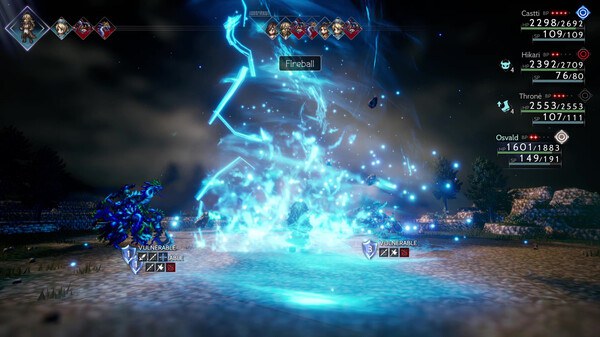
OCTOPATH TRAVELER II’s Break and Boost system asks you to remove an enemy’s shield points by exploiting weaknesses. At zero, that foe is stunned and vulnerable for a turn. Square Enix describes Boost Points as a resource for adding attacks, strengthening a hit, or improving support and healing. The tactical question is therefore not simply “Can I break this enemy?” It is “What can my party do with the opening?” [1]
A useful battle plan has two clocks: the enemy shield count and your party’s next actions. Shield pressure tells you how close the opening is; BP tells you how much force you can concentrate when it arrives. Spending BP just because it is available may create damage now but leave no strong follow-up. Saving every point can be just as passive if the enemy is about to act. Think of BP as a way to shape a turn, not as a score to maximize.
Read the party before choosing a weakness hit
Start by checking three things: the target’s remaining shield points, the weaknesses your party can hit, and the order allies will act. Weakness discovery helps later turns, but revealing a weakness is not automatically best if an enemy is about to deliver a dangerous move. A multi-hit skill may remove several shield points; a single unboosted action may preserve BP for the opening. Square Enix describes Break as exploiting weaknesses, while the particular sequence depends on your party and turn order. [2]
Imagine a dangerous foe with two shield points remaining. One ally can use a known multi-hit attack that removes both, while another has a powerful boosted action ready. If the multi-hit action comes first, it can create the vulnerable turn for the second character. If the boosted attack would arrive first, spending it before the break may waste its best value. The aim is not to follow a fixed formula; it is to make sequence serve the opening.
Choose what the opening is for
Before the final shield point disappears, assign the break turn a job. It might be a burst of damage, a healing window, a chance to apply support, or an opportunity to remove one foe before its next turn. Boosting every attacker may feel satisfying, but it can overspend against a nearly defeated target. If a boss is about to retaliate, investing heavily during the stunned turn may be exactly right.
Breaking creates time; boosting decides how much of that time you convert into progress. One character can use a low-cost multi-hit skill to reach zero shields, while another can use the stunned turn for a heavier action. The order is a plan, not a universal recipe: jobs, skills, equipment and weaknesses change the options.
Use a small worked example
Suppose two enemies remain. One has a known weakness and one is still unknown. You can spend BP to attack the known target repeatedly, or use a cheaper action to test whether the second target can be pressured safely. If the known enemy is about to act, securing its break may prevent the immediate threat. If it is not threatening, learning more can improve your next round.
A practical routine is: inspect the next enemy action, identify a reliable route to zero shields, decide which ally benefits most from the vulnerable turn, then spend BP only where it improves that route. Afterward, reassess. This turns “attack until the break appears” into a sequence of questions answered with the information on screen.
Keep the plan flexible
Not every fight needs a staged burst. Ordinary enemies may be safer to remove quickly, while a longer encounter rewards conserving points and learning patterns. If your plan is “save BP,” know what moment you are saving it for. If your plan is “break now,” know what the party will do during that stunned turn.
The best break is not necessarily the earliest one. It is the one that changes the next turn in a way your party can use. Weakness attacks create the opening, and Boost Points make the opening matter. Revise as new weaknesses appear, allies take damage or turn order shifts.
Primary work & further reading
Primary work: Octopath Traveler II. Character and story readings are editorial interpretations. The publisher reference below identifies the work and its premise.