The Zashiki-warashi arc makes a lodging house hold a secret
The Zashiki-warashi arc turns a lodging house into more than a place where strangers meet. Its rooms and social rules shape what can be said, so the Medicine Seller’s investigation must account for silence as well as events.

Coverage: Covers the Zashiki-warashi arc’s lodging-house setting, social silences, and investigative setup; avoids its final explanation and graphic details.
A lodging house is a social arrangement
The Zashiki-warashi arc begins in a setting built around temporary residence. A lodging house gathers people who do not necessarily know one another, gives them rooms and shared spaces, and places limits on how much of their private lives become public. It is neither a home in the fullest sense nor a truly anonymous place. That in-between quality makes it an effective setting for a mystery: its residents are close enough to affect one another, but their connections may remain partial or concealed.
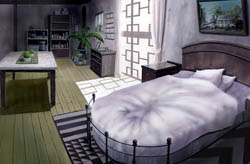
The building matters because it organizes contact. A guest’s presence can be noticed without being understood, and the movement between private rooms and common areas gives people ways to encounter one another while keeping something back. The setting therefore creates more than atmosphere. It makes questions about who belongs, who can speak, and who has access to information part of the arc’s underlying tension. The Medicine Seller enters a place whose everyday arrangements already govern what a stranger can learn.
Politeness can protect silence
In a shared lodging house, restraint may look like good manners. Residents and visitors can avoid intruding, refrain from asking personal questions, and preserve a fragile peace by treating troubling subjects as private. Such habits are understandable, but they also make silence difficult to interpret. A person who does not speak may be protecting themselves, respecting another person’s boundaries, or responding to pressure. The arc lets these possibilities complicate the investigation without turning every quiet exchange into a confession.
This social quiet changes the work of gathering information. The Medicine Seller cannot assume that an absence of dispute means a lack of conflict, or that a courteous answer contains everything relevant. He has to observe how people relate to the place as well as what they tell him. The tension comes from an ordinary social skill—keeping the peace—doing two jobs at once: maintaining coexistence and making difficult knowledge harder to reach. The mystery grows within that gap between what can be politely passed over and what may still require attention.
The investigation follows boundaries
The Medicine Seller’s investigation gives the lodging house a second life as a set of boundaries to examine. Private rooms suggest limits on access; shared areas allow people to meet while keeping their motives obscure. These divisions influence what is visible and who gets to speak in a given situation. The case cannot be approached as if the building were an empty diagram. Its spaces belong to people whose habits, relationships, and reserve shape the evidence available to him.
That attention complements the arc’s supernatural premise. The uncanny is not presented as something that can be understood solely by naming a strange manifestation. A meaningful inquiry must also ask what circumstances surround it and how the people there describe their experience. The Medicine Seller’s presence does not erase the residents’ differing perspectives; it brings their accounts into a setting where they can be compared. The story’s investigative tension rests on this process of attending to relationships rather than rushing to a single explanation.
An intimate setting holds pressure
A lodging house may seem modest beside a grand estate or an isolated wilderness, but its scale makes its uncertainties feel close. People share a place while retaining separate lives, and the boundary between public routine and private concern is easy to cross yet difficult to understand. The arc’s opening setting uses that closeness to make ordinary exchanges matter. What is withheld can shape the atmosphere as powerfully as a visible event, because everyone remains near enough for silence to have consequences.
The result is a mystery grounded in social space. The building is not simply where the supernatural story happens; it helps determine how the story can be investigated. Its shared rooms invite observation, its private boundaries limit certainty, and its norms of discretion complicate speech. By making the Medicine Seller attend to all of these conditions, the arc turns setting into an active pressure on interpretation. The lodging house holds a secret in the sense that its routines contain the conditions for concealment—and that is enough to make the investigation uneasy.
Primary work & further reading
Primary work: Mononoke. Character and story readings are editorial interpretations. The publisher reference below identifies the work and its premise.