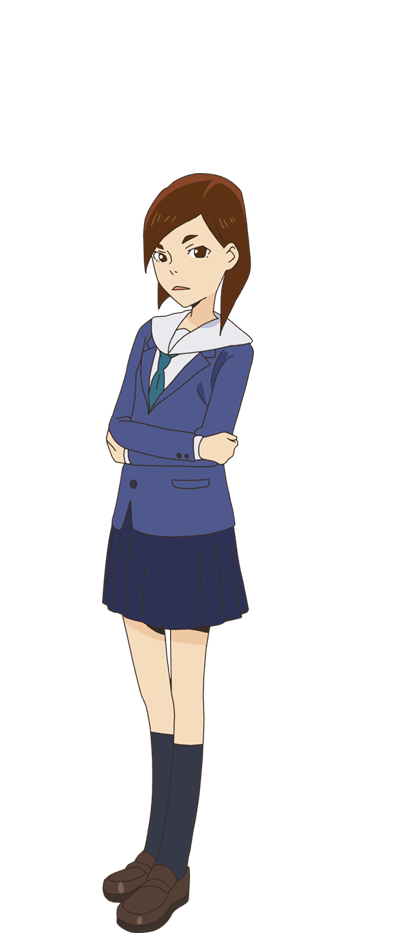
Kanamori would like Eizouken to finish something
Sayaka Kanamori’s practical questions give the club’s creative energy a path toward making something. Her early role shows how money, time, and negotiation can protect an idea by giving it workable limits.
Coverage: Covers Kanamori’s producer role and the club’s early plans; no later developments.
A good idea still needs a route
Sayaka Kanamori listens to the club’s ambitions with an eye for what has to happen next. An exciting concept may inspire the group, but it does not automatically become a finished animation. Someone must consider how much time the work needs, what resources are available, and what agreements will let the project proceed. Kanamori takes up that practical space. Her questions shift the group from imagining what might be made toward confronting the conditions under which it could be made.
That shift is not a rejection of the club’s creativity. It is a recognition that enthusiasm alone cannot carry a project through every stage. A deadline gives work a boundary; money and materials shape the choices available; negotiation determines whether the group can act. Kanamori’s attention to these matters can sound blunt because she treats them as real. Her perspective makes the cost of an idea visible before the group mistakes the desire to create for the ability to complete.
Money is part of the creative situation
Kanamori’s attention to money matters because it turns vague ambition into choices. A project cannot assume limitless resources, so the group has to consider what it actually needs and what it can secure. That calculation affects the form an idea might take. Some plans may require more time or support than the club can expect; others can be shaped to fit the means at hand. Practical limits do not decide whether an idea is worthwhile, but they influence what can be attempted now.
The series uses Kanamori to make this pressure part of the group’s creative life rather than an offstage inconvenience. Her focus on resources asks the others to take their plans seriously enough to account for consequences. That seriousness can feel like friction, especially when an imaginative conversation seems to be gaining momentum. Yet the friction has a purpose: it forces the group to distinguish the excitement of a concept from the work required to realize it. Financial awareness becomes one way of respecting the project’s existence.
Deadlines give ambition a shape
Time is another condition Kanamori refuses to treat as abstract. If a group intends to finish something, it has to decide what can be done before a deadline and what must be simplified or postponed. That judgment is a creative act in its own right. It makes the members identify which parts of an idea are essential to its effect and which details can wait. Without such decisions, every possibility competes for attention and the project risks remaining a collection of intentions.
Kanamori’s role makes completion a shared responsibility. She can press the club to choose a scope that matches its circumstances, but the group still has to do the creative work. Her practical intervention does not replace the others’ imaginations; it gives their imaginations a test. Can this be completed with the time and help available? The question can narrow a plan, but it also gives the members a chance to make a real object rather than preserve an ideal version forever in conversation.
Negotiation can defend the work
Kanamori is often the person who turns a need into a request and a request into a discussion. That negotiating stance may seem less romantic than the club’s vivid ideas, but it is a form of advocacy. To secure time, space, or support, she has to explain why the work deserves those things and what the group can offer in return. Her directness gives the club a representative who understands that creative freedom often depends on dealing with other people and their expectations.
Reading Kanamori as merely anti-art misses the way her practicality serves the group’s ambition. She does not ask the others to stop imagining; she asks them to account for the conditions that make action possible. The club’s creative energy gains a route toward completion when someone is willing to negotiate, budget attention, and set limits. Kanamori makes imagination finishable by treating it as work worth organizing. Her realism does not diminish the idea. It gives the idea a chance to leave the realm of possibility.
Primary work & further reading
Primary work: Keep Your Hands Off Eizouken!. Character and story readings are editorial interpretations. The publisher reference below identifies the work and its premise.