Eizouken's rough drawings invite the viewer into the idea
When Eizouken shifts from ordinary spaces into sketches and imagined worlds, the change in form makes invention visible as it happens. Rough drawings invite the viewer to share the club’s process of possibility.
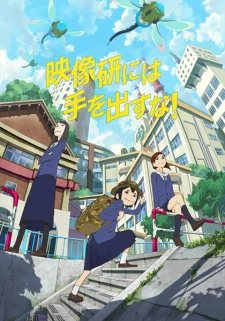
Coverage: Covers the series’ early transitions into sketches and imagined worlds; no later developments.
A change in drawing changes the world
Keep Your Hands Off Eizouken! often lets a scene’s visual language change when a character begins to imagine. A familiar space can give way to a sketch-like world where proportions, movement, and perspective serve the idea being explored. The shift does more than decorate a conversation with fantasy. It makes visible the act of imagining: the ordinary setting is still present as a point of departure, but the viewer now sees what the characters are trying to build from it.
Because the transition is so direct, the imagined world feels connected to the work of making it. The series does not require a long explanation before an idea can take visual form. A thought can open into space, and the audience can follow its possibilities as the characters do. That formal movement gives creative discussion a physical dimension. Imagination is not hidden behind dialogue; it changes what the screen can show and how a place can be understood.
Roughness preserves possibility
The sketches matter partly because they look open to revision. Their roughness leaves room for the eye to continue the work: to imagine a missing detail, test a shape, or wonder how an imagined object might move. A polished image tends to present its decisions as settled. A sketch can make the decision-making itself feel present. It shows the idea while preserving the sense that the idea may still change.
That unfinished quality also suits the club’s early creative process. The characters are not simply presenting a completed world for admiration; they are exploring what a world could contain. Rough lines help the viewer read their inventions as proposals. The image says, in effect, that this is a direction worth considering, not necessarily the final answer. By letting the drawing remain visibly provisional, the series makes the pleasure of invention available to the audience rather than hiding it behind a finished surface.
The viewer joins the act of imagining
These visual shifts create a particular relationship with the viewer. We are invited to move between the characters’ present surroundings and the possibility taking shape in their minds. That movement asks us to do more than receive a premise. We must connect what is being discussed to what the image now lets us see. A setting can become an imagined machine or a setting for action because the series has trained us to recognize the leap between an observed detail and a creative use for it.
The invitation makes the audience a temporary collaborator. We can follow the logic of a proposal, notice what the drawing emphasizes, and anticipate how an imagined space might work. This does not mean every idea has to be fully explained or resolved. The gaps are part of the pleasure: viewers can supply connections while the characters continue to develop their own. The form makes participation feel natural because a sketch is already an appeal to look, interpret, and imagine alongside its maker.
The form honors process as a subject
By changing visual modes, Eizouken makes creative process part of what the audience experiences. Conversation can become space; a possibility can take on apparent scale; a rough drawing can carry an energy that a description alone would not. The series treats these shifts as storytelling, not as a break from it. They let the viewer sense how quickly an idea can rearrange the world when someone is willing to look at it differently.
That approach gives the show’s early creative scenes a clear argument of their own: an idea becomes more vivid when it can be explored before it is complete. The sketches do not promise that every possibility will become a finished work. They make room for a different pleasure, the shared recognition that something new has begun to take shape. By letting roughness remain visible, the series invites us into the idea at the moment it is still alive with choices.
Primary work & further reading
Primary work: Keep Your Hands Off Eizouken!. Character and story readings are editorial interpretations. The publisher reference below identifies the work and its premise.