Barbara, Amber, Kaeya: learning Genshin Impact's elemental handoffs
Elemental reactions make party switching meaningful by letting one character’s application shape what the next can do. Understanding that handoff offers a practical way to plan a team without relying on rankings or complicated damage claims.
Coverage: Covers the basic elemental application and reaction system, including stable Hydro–Pyro examples; excludes patch-specific rankings and exact damage values.
Think in handoffs, not isolated attacks
A four-person party is easier to understand when its characters are treated as a sequence of contributions. One character applies an element; another can introduce a different one; the resulting reaction changes what the encounter asks of the party. Elemental application is the act of putting an element onto a target or into the surrounding situation. A reaction occurs when compatible elements meet. The key decision is therefore not only which character is strong, but what their action leaves ready for the next character.
This way of thinking makes switching purposeful. If a target is affected by Hydro, a Pyro character can create the familiar Vaporize reaction by applying Pyro. The first action has not disappeared when the second begins; it has become the setup. The party gains a shared vocabulary because each member can respond to a state another member created. Instead of viewing four characters as four separate sources of attacks, the player can ask what one action enables after it.
Reactions have different kinds of consequences
The reaction system includes outcomes that serve different roles. Some reactions primarily change the damage relationship between elemental applications, while others create an additional effect that can influence combat space or enemy behavior. Vaporize, formed from Hydro and Pyro, is a clear example of an amplifying reaction: the meeting changes the impact of an elemental hit. Other reaction families are better understood through the extra conditions they create, such as an area effect or a response that helps control nearby opponents.
The distinction matters because a reaction’s value is not a single number in every situation. A player considering an amplifying reaction is thinking about the sequence and strength of the relevant hits. A player using reactions with control or area effects may care more about where enemies are and whether the effect helps manage a group. This is a useful broad classification, not a promise that every reaction will solve every encounter. The practical question is what kind of problem the reaction helps address.
Plan around what the next character can use
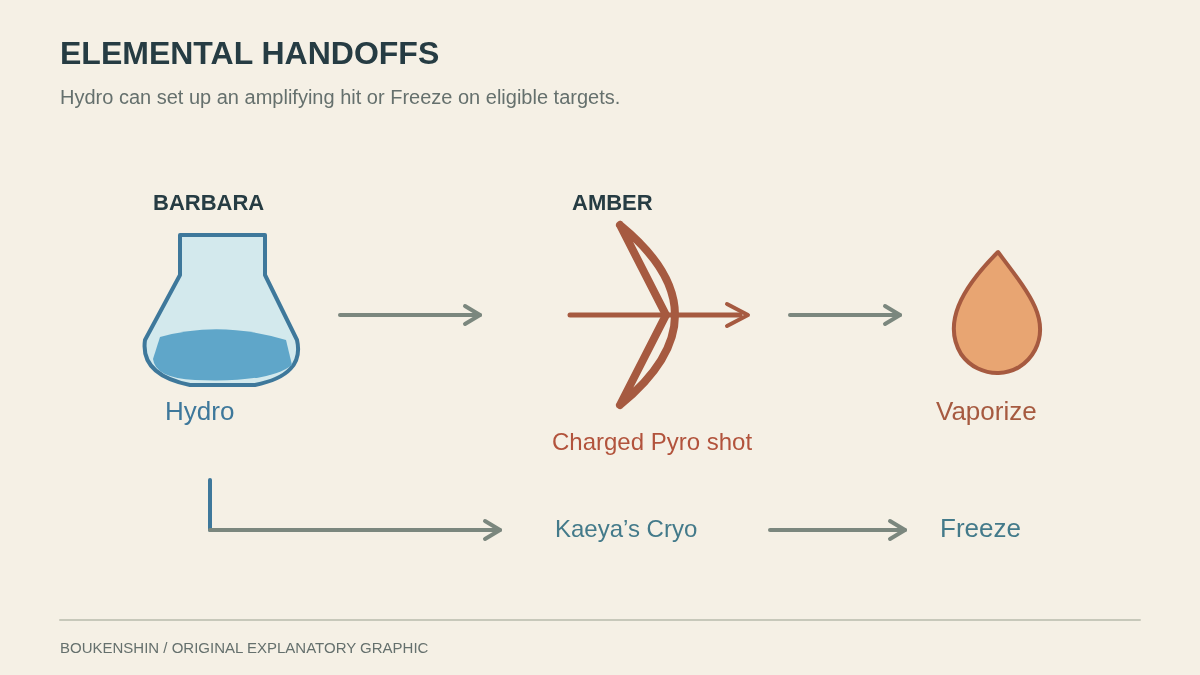
Barbara and Amber offer a concrete way to see the handoff. Barbara’s normal attacks apply Hydro. Against an ordinary enemy that can retain that aura, hit with Barbara, switch to Amber, and use a fully charged aimed shot to apply Pyro and trigger Vaporize. The charged shot matters: Amber’s ordinary bow attacks deal physical damage, so simply choosing a Pyro character does not make every attack apply Pyro. The setup asks you to connect the character, the attack type and the element currently on the target. If Hydro has already been consumed or removed, the next Pyro hit cannot use that same setup again.
Kaeya offers a different follow-up to Barbara’s Hydro. His elemental skill applies Cryo, which can Freeze eligible enemies already affected by Hydro. Against an ordinary Hilichurl, that creates an opening to reposition or continue attacking; bosses and other resistant enemies need different expectations. This is a different purpose from amplifying Amber’s charged shot. Both sequences begin with Hydro, but one aims to strengthen a hit while the other interrupts an enemy’s movement. Try reading the elemental state before choosing the next character, rather than pressing every available skill and assuming the same reaction will follow.
Build a party around complementary jobs
A four-person party needs complementary ways to create and use elemental conditions. That does not mean every member must participate in a reaction every moment. A character can contribute through a different role, and the player may need to adjust when targets or circumstances change. But it is useful to notice whether the roster offers a workable chain: someone who can apply an element, someone who can respond to it, and enough flexibility to act when the preferred setup is unavailable.
The shared vocabulary of reactions makes those roles legible. Instead of asking whether a character belongs in a universally best lineup, ask what they can apply, what can follow, and which kinds of encounter that sequence addresses. This approach remains useful without relying on exact multipliers or current rankings. Elemental combat becomes a conversation among party members: one creates a condition, another answers it, and the player decides whether that exchange suits the moment.
Primary work & further reading
Primary work: Genshin Impact. Character and story readings are editorial interpretations. The publisher reference below identifies the work and its premise.