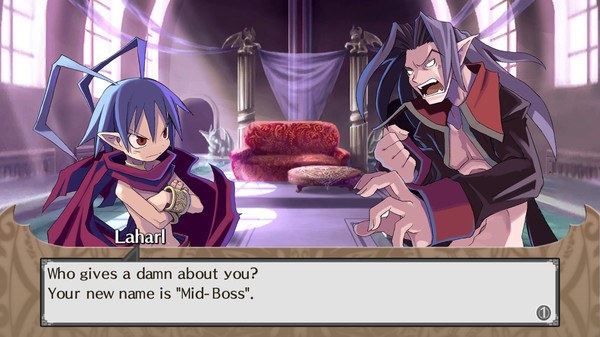
Laharl inherits a throne and an argument about family
In Disgaea’s opening, inheritance gives Laharl a title and a problem: he must claim authority from the father whose rule he insists he no longer needs. Etna and Flonne turn that contradiction into a lively contest over what leadership means.
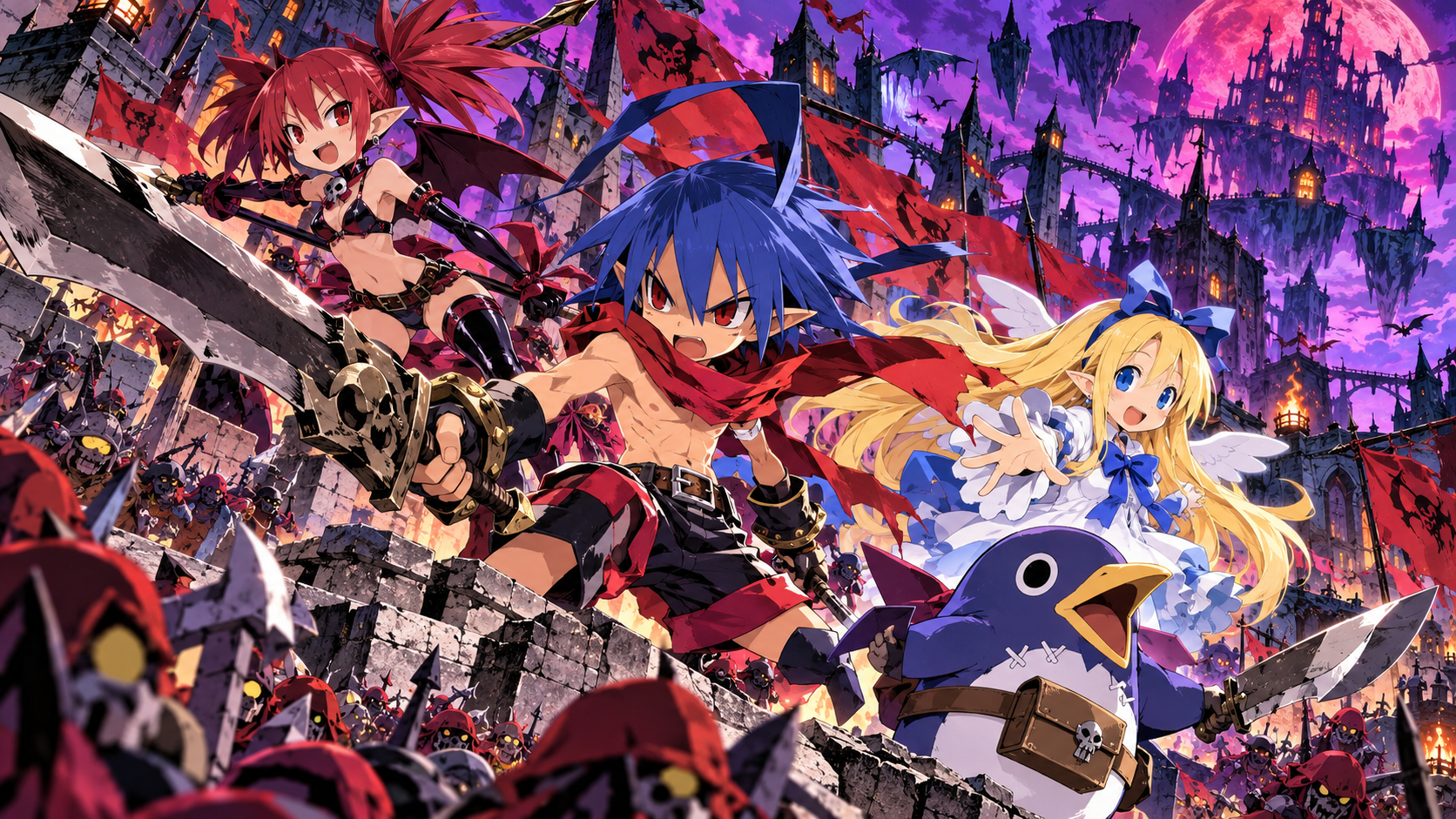
Coverage: Covers the opening setup and early challenges to Laharl’s claim; no ending events.
A claim built on absence
Laharl’s inheritance begins with a vacancy. King Krichevskoy is dead, and the young demon wakes to find the Netherworld without its ruler. The throne is therefore less a prize he wins than a responsibility he discovers waiting for him. Yet Laharl speaks as if succession merely confirms what he already is: the strongest, most deserving demon. The gap between that certainty and the circumstances of his return gives the opening its central tension.
A throne carries the authority of the person who occupied it before. Laharl can treat his father as an obstacle in memory, but he cannot inherit the position without inheriting its meaning. His claim to complete independence depends on a legacy he did not create. The game makes that contradiction comic rather than solemn: a self-proclaimed sovereign has to prove himself in a realm that has been getting along without his rule.
Etna tests what authority buys
Etna’s presence makes the inheritance personal and practical. She has been managing the castle and its Prinnies during Laharl’s long absence, so his claim arrives in a place already shaped by her labor. She does not greet him as an unquestioned monarch. Her irreverent manner keeps puncturing the idea that a title alone should settle who is in charge, while her ambition gives her a reason to stay close to the seat of power.
That challenge is not simply a bid to replace him. Etna understands the routines and leverage of the castle, and she can use them while Laharl is still learning what his return demands. Their exchanges make authority look like an ongoing negotiation: Laharl has the hereditary claim, Etna has demonstrated competence, and neither fact erases the other. The comic friction exposes how much his independence relies on people who have kept his inheritance intact.
Flonne asks what a ruler should want
Flonne enters from a different direction. Sent to assassinate the Netherworld’s ruler, she arrives with an idea of good and evil that does not fit comfortably with the demons she meets. Her insistence on love challenges Laharl’s values, but it also challenges his assumption that command is self-justifying. If ruling means more than possessing the strongest claim, then his conduct toward others matters, even when he dismisses their moral language.
Etna and Flonne thus offer rival pressure. Etna treats the throne as a source of influence worth pursuing; Flonne treats the ruler as someone answerable to an ideal. Laharl resists both forms of judgment, which helps define him more precisely than simple arrogance would. He wants recognition without dependence and power without moral scrutiny. The opening keeps those desires in collision, rather than making either woman a mere audience for his boasts.
Inheritance makes independence impossible
The early setup turns succession into a family argument without requiring Krichevskoy to be present. Laharl’s father remains the measure against which the son defines himself: the dead king’s realm is the inheritance, and his absence is the opening Laharl must fill. Even a son who refuses to imitate his father is still responding to him. The throne makes that response visible, converting private defiance into a public claim that others can contest.
Laharl’s independence is therefore contradictory in an interesting way. He wants to rule as though no one made him, yet his position depends on a father’s title, Etna’s work, and a realm whose inhabitants can refuse to take him seriously. The opening does not resolve those pressures; it makes them the source of the party’s comedy and conflict. His claim is real, but earning its meaning requires more than sitting in the inherited seat.
Primary work & further reading
Primary work: Disgaea. Character and story readings are editorial interpretations. The publisher reference below identifies the work and its premise.