One landscape, several histories in Chrono Trigger
Chrono Trigger’s changing eras make familiar routes carry historical meaning. By revisiting places whose landscapes and communities have transformed, the player learns to read the map as a record of human decisions, survival, and loss.
Coverage: Discusses early era changes and the implications of revisiting familiar locations; contains no final-boss or ending details.
A familiar route can become unfamiliar
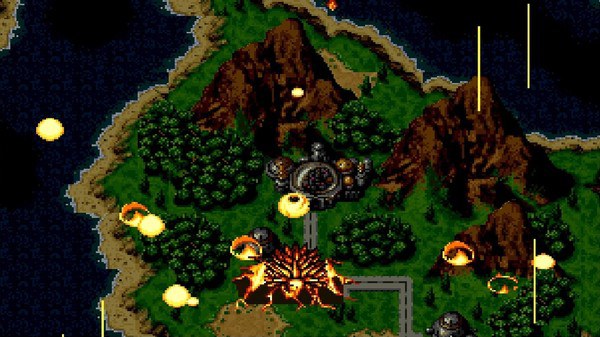
Chrono Trigger’s time travel changes the meaning of moving through the world. A place first encountered as a current destination may later appear in another era, with altered settlements, terrain, or political circumstances. The map is therefore more than a set of routes connecting battles and towns. It becomes a comparison the player performs by memory: this is where I stood before, but the people and conditions around it have changed.
That comparison gives backtracking a purpose beyond navigation. Revisiting a location can feel like reading a second layer into the first visit. A town’s buildings or a stretch of wilderness may suggest what endured, what was built, and what disappeared. The game does not need to pause for a lecture every time the party travels. The player supplies part of the historical understanding by carrying an image of the earlier place into the later one.
Landscapes show history at human scale
The game’s early transformations make history tangible through ordinary geography. A region can be recognized across eras even when its inhabitants live differently or its settled areas have shifted. That continuity matters: time travel does not send the party to a collection of unrelated worlds. It places changed communities on ground the player already knows, encouraging attention to the relationship between environment and daily life.
This approach also makes the world’s ecology feel vulnerable. The land is not simply scenery waiting for the heroes to cross it. Changes in settlement and natural surroundings imply that people have depended on, reshaped, or failed to protect their environment. Chrono Trigger’s map does not offer a neutral backdrop against which history happens; it lets the player see history as a change in the conditions of living. The implication emerges from contrast, not from a system that measures environmental damage.
Travel links consequence to choice
The eras connect because the game makes the player travel between them. A historical fact delivered in dialogue can remain abstract, but a route that looks different after a journey has physical presence. The party’s ability to move through time turns the player into a witness to consequences. Even when the characters are not responsible for the changes they encounter, their movement makes those changes legible: the past and future are not separate settings but parts of one shared world.
This structure gives exploration a moral edge without making every discovery a simple lesson. A transformation may reveal progress, hardship, or loss, and the player must interpret what the difference means. Chrono Trigger’s map invites questions about who benefited from a change and who had to live with it. It does not need to supply one answer for every place. The important point is that a landscape’s history becomes something the player can compare rather than merely hear about.
The map asks the player to remember
Chrono Trigger’s changing geography works because the player retains a mental map. Returning to a location rewards that memory: recognizable landmarks help make differences meaningful. If each era were an entirely new environment, time travel might feel like a sequence of excursions. Shared places instead make it possible to notice what time has done. The map’s argument depends on continuity as much as change.
As a result, travel becomes a way of understanding rather than a pause between story scenes. The player learns to read a familiar place for signs of its past and possible future, while accepting that no single visit can explain its full history. Chrono Trigger makes time visible by making space memorable. Its map argues that a world’s transformations matter most when the player can recognize what has been transformed.
Primary work & further reading
Primary work: Chrono Trigger. Character and story readings are editorial interpretations. The publisher reference below identifies the work and its premise.