Waiting for Fire Whirl: cooperation in Chrono Trigger's combat
Dual Techs ask you to coordinate two ready characters and spend both of their opportunities to act on one shared technique. Crono and Lucca’s Fire Whirl shows how that can change an encounter through its target pattern and positioning, not simply through bigger damage.
Coverage: Covers the general Dual Tech system and Crono and Lucca’s Fire Whirl; no later plot revelations.
Two ready characters, one shared technique
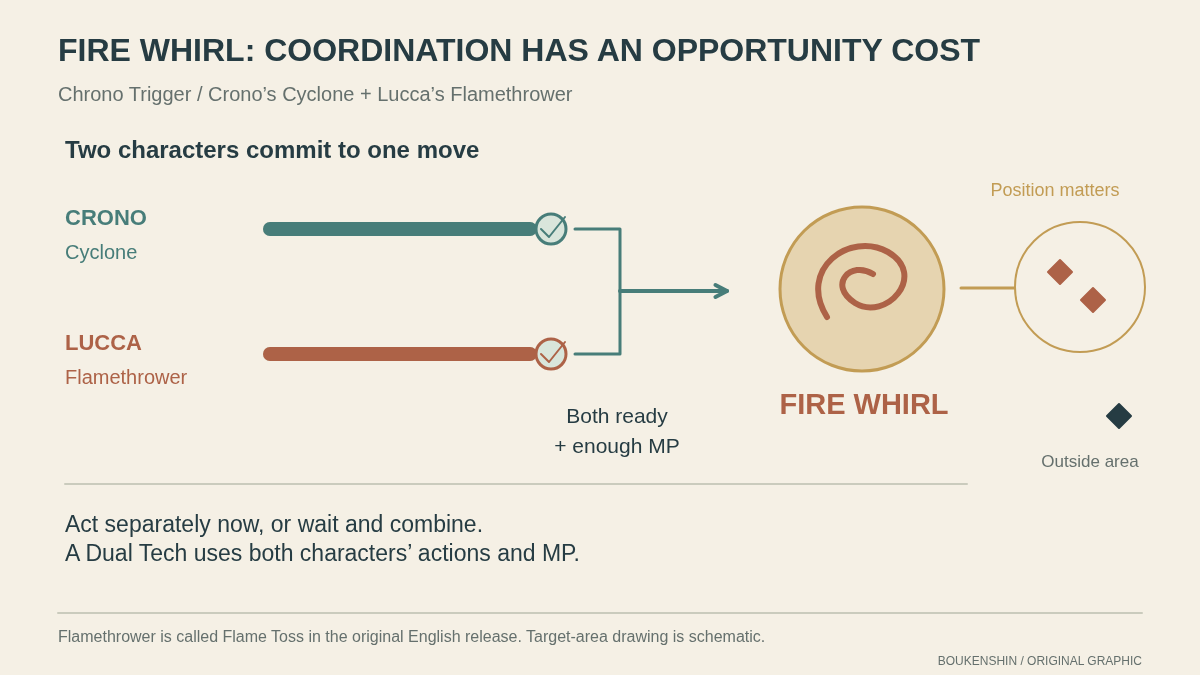
A Dual Tech is a single coordinated action that uses techniques from two characters. Both participants must be available and ready, and each must have enough MP to contribute. When Crono and Lucca use Fire Whirl, for example, Crono combines Cyclone with Lucca’s Flamethrower (called Flame Toss in the original English release). It is not two independent attacks queued together: the pair commits to the combined move, so you give up the option of using each character’s technique separately at that moment.
That makes the timing decision concrete. If Crono is ready while Lucca is still recovering, Crono can use Cyclone on his own rather than hold his action for Fire Whirl. If both are ready and have the MP, you can choose the Dual Tech instead. The first choice lets Crono act sooner; the second coordinates the pair and uses both characters’ resources. Think of readiness and MP as part of the opportunity cost, alongside the actions each character could take alone.
Fire Whirl changes who a move can reach
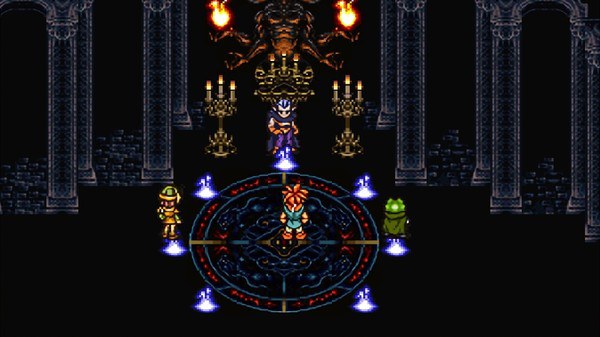
Fire Whirl is useful to understand because its appeal is not just that two characters act together. Its attack pattern and positioning matter: Crono’s Cyclone and Lucca’s Flamethrower combine into an area attack, letting the pair target multiple nearby enemies when their positions make that worthwhile. Before selecting it, look at where the enemies are and whether the ones you need to hit fall within the move’s reach. A group clustered in range gives the pattern a purpose; scattered enemies may make a focused individual attack more practical.
Separate that target pattern from raw damage. A combined technique can be valuable because it reaches several enemies at once, even when your decision is really about coverage rather than maximizing a hit on one target. In a hypothetical fight, say two dangerous enemies are close enough for Fire Whirl while a third is farther away. Choosing Fire Whirl directs the team action toward the pair; choosing separate attacks could let Crono focus on one enemy and Lucca use Flamethrower elsewhere. The tradeoff is coverage together versus independent targeting.
Check what each character needs to do
Before committing both characters, read the whole battle. If an ally needs healing, or one enemy must be stopped immediately, spending Crono and Lucca together on Fire Whirl may leave that need unanswered. If the enemy group is the pressing threat and the pair can catch several targets, the combined action may solve more of the current problem. The useful question is not simply whether the Dual Tech is available; it is what the party loses by using it now.
For example, imagine Crono and Lucca are both ready, but another party member is in danger and Lucca could use an available individual action to help. Choosing Fire Whirl means taking the area attack against the enemies; choosing Lucca’s separate action addresses the ally’s immediate need while Crono remains free to attack. Neither choice is universally right. The situation on screen determines whether shared coverage or a character’s separate responsibility matters more.
Build options through techniques, not a friendship score
Dual Techs depend on compatible learned techniques and on having the right characters in the party. Friendship may be part of how players describe the story’s appeal, but a friendship score does not automatically unlock every partner combination. As you acquire techniques, check which combinations become available and what each one actually does. Fire Whirl is a specific match—Crono’s Cyclone with Lucca’s Flamethrower—not a general promise that any two allies can combine any moves.
A practical habit is to check three things when a Dual Tech is offered: are both named participants ready, can each pay the MP cost, and does the move’s target pattern suit the current enemies? Then compare it with what those two characters could accomplish separately. That quick check keeps combinations from becoming a default button press. Dual Techs make cooperation visible because you choose to coordinate particular abilities at a particular moment, with a real cost in timing, MP, and flexibility.
Primary work & further reading
Primary work: Chrono Trigger. Character and story readings are editorial interpretations. The publisher reference below identifies the work and its premise.