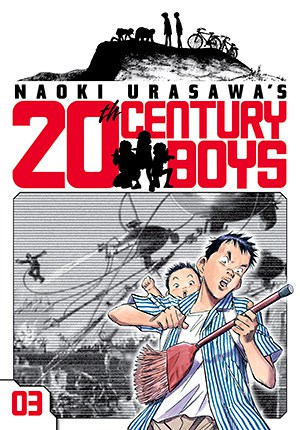
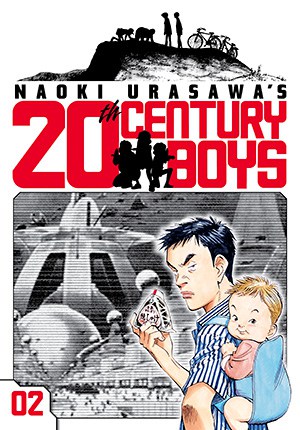
Kenji's childhood game becomes an adult mystery
A shopkeeper’s routine gives Kenji a narrow, practical view of the world, until familiar marks begin connecting his present to an old game. The opening turns memory into a problem with consequences.

Coverage: Opening premise and early childhood memories only; no Friend identity or later timeline solutions.
A life measured in small errands
At the start of 20th Century Boys, Kenji Endo’s days are shaped by the convenience store he runs and the young niece in his care. The shop is a place of immediate needs: customers come and go, goods must be stocked, and family responsibilities cannot be postponed for some grand calling. This routine makes Kenji legible as an adult before the story asks what sort of boy he used to be.
The scale of his life matters. Kenji is not introduced as a detective deliberately searching for an old secret. He has a job, a household and obligations that keep his attention close to the present. When the past starts to intrude, it arrives in a life with little spare room for it. The mystery gains weight because investigating it means looking away from real duties, even if only for a moment.
A familiar mark changes the meaning of the present
The opening premise links troubling events to symbols and ideas from a childhood game Kenji and his friends once made up. That connection does not immediately make the past a reliable guide. It makes the old game newly difficult to dismiss. A mark that once belonged to play can now seem like evidence, but evidence still needs interpretation: who remembers it correctly, what did it mean then, and how has its meaning changed?
This shift turns recognition into an uneasy act. Kenji has enough familiarity to feel that the symbols matter, but familiarity is not the same as understanding. The same image can feel harmless in a child's notebook and ominous when encountered in adult life. By making that contrast central, the manga lets suspense emerge from an ordinary mental reflex: seeing something known and wondering whether it has always been more serious than it looked.
The childhood game offers a map with missing pieces
The game gives Kenji a framework for organizing what would otherwise be a collection of alarming coincidences. Childhood play had rules, roles and a future-facing sense of adventure. Returning to that framework offers the comfort of a map: perhaps the present can be explained by going back to the moment the map was drawn. Yet the framework was invented by children, and invention leaves room for gaps, exaggeration and disagreement.
That limitation keeps the mystery from becoming a simple puzzle in which the past supplies every answer. Kenji must decide how much trust to place in his own recollections and in those of the people who shared them. The game is useful because it gives them a common reference; it is unstable because a shared reference does not guarantee shared memory. The childhood world guides inquiry while making it necessary to ask who is doing the remembering.
Adult responsibility gives the mystery its stakes
The opening tension rests on a collision between two kinds of responsibility. Kenji’s daily life demands care for people close to him, while the resurfacing symbols suggest a larger danger that cannot be met by tending a shop. The story does not need to make ordinary work trivial to create urgency. On the contrary, each familiar obligation shows what Kenji stands to neglect if the mystery claims more of his attention.
This is why the childhood game becoming an adult mystery feels like a change in moral scale, not merely a clever callback. What began as an imagined adventure now presses against the limits of an adult life built around practical needs. Kenji’s past supplies the first clues, but his present gives those clues consequence. The opening leaves the old game unresolved and makes that uncertainty productive: understanding it will require him to risk the steadiness he has managed to build.
Primary work & further reading
Primary work: 20th Century Boys. Character and story readings are editorial interpretations. The publisher reference below identifies the work and its premise.