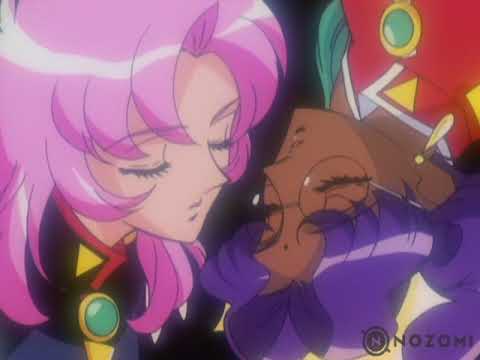
Wakaba makes Utena's ordinary school life matter
Wakaba’s friendship with Utena gives the academy a life beyond duels and ceremonies. Through familiar school interactions, the series makes affection feel consequential and shows how much Utena’s public image depends on everyday companionship.

Coverage: Covers Wakaba’s early friendship with Utena and their ordinary school life; no later character arc outcomes.
A friend sees a student, not an emblem
Ohtori’s presentation makes Utena easy to turn into an image: the girl in a boyish uniform, the student willing to step into danger, the figure associated with a princely ideal. Wakaba’s presence helps keep that image from taking over the whole character. She knows Utena in the everyday context of school, where friendship consists of spending time together and responding to one another as familiar people rather than as symbols.
That familiarity matters because Utena’s aspiration is so public. Other students can admire her appearance or interpret her actions through the academy’s rituals. A friend can give her a different kind of recognition: the kind built from continued company rather than from a dramatic victory. The anime does not need Wakaba to explain Utena in order to make this contrast felt. Their ordinary connection makes visible that Utena’s life at school includes relationships that have nothing to do with being a prince.
Everyday affection has its own dramatic weight
The series’ duels are loud, highly organized events. Friendship occupies a quieter register: classroom encounters, familiar attention, and the unremarkable ease of people who know one another. That quieter register is not empty space between major scenes. It gives the audience a sense of what school life might mean to students when the academy is not arranging them into ceremonial roles or rivals.
Wakaba helps establish that ordinary life has emotional stakes of its own. A friend’s interest can make Utena’s presence matter without demanding that she rescue anyone. This is a useful counterweight to the heroic script she is trying to inhabit. If every relationship were expressed through a crisis, the prince ideal would seem like the only way Utena could be valuable. Wakaba’s companionship suggests that shared attention and affection already have significance, even without a spectacle to certify them.
Friendship moves beyond the school’s formal ranks
Ohtori organizes student life through visible distinctions: uniforms, titles, ceremonies, and the prestige attached to dueling. Friendship offers a different way of relating. It can be direct and unceremonious, shaped by mutual familiarity rather than a title that gives one student power over another. Wakaba’s connection with Utena therefore helps define the social world outside the academy’s formal contests, even though both friends remain within the same school.
This contrast does not make friendship a magical escape from Ohtori’s expectations. It gives the story another measure of what matters. The arena can turn a relationship into public theater; everyday affection can let two people meet without needing an audience or a winner. Wakaba’s role is modest in scale, but that scale is exactly the point. Her connection with Utena gives ordinary school relationships a presence sturdy enough to stand alongside the series’ more extravagant rituals.
Ordinary companionship restores proportion
Utena’s princely self-image can pull attention toward dramatic gestures. Wakaba’s everyday friendship restores proportion by locating those gestures within a continuing student life. The person who fights in a duel is also someone with a friend at school. That simple fact changes the meaning of heroism: it becomes one part of Utena’s life, not the sole proof that she deserves to matter.
Through Wakaba, the anime allows affection to register without turning it into an award or a test. Their friendship gives Utena a social world in which care can be offered through presence, familiarity, and shared time. It also gives the viewer a reason to value the moments that the academy’s spectacle might otherwise overshadow. Utena’s ordinary school life matters because her ties to other students are not lesser versions of the duels; they are a different, more intimate kind of significance.
Primary work & further reading
Primary work: Revolutionary Girl Utena. Character and story readings are editorial interpretations. The publisher reference below identifies the work and its premise.