Luffy carries Shanks's promise on his head
Luffy’s hat is more than a keepsake: it gives a child’s ambition a history, a witness, and a concrete shape. Its place in his first steps toward the sea shows how a promise can travel with its bearer.
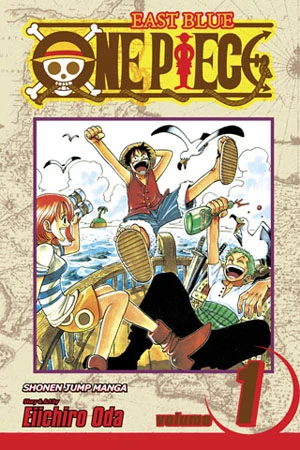
Coverage: Early East Blue manga, including Luffy’s childhood encounter with Shanks and his departure to begin his journey; no later revelations.
A dream needs an object
Luffy’s ambition is enormous and, at first, almost impossible to picture. He wants to become King of the Pirates, a title that sounds like a distant finish line rather than a plan. The straw hat gives that vast wish a visible form. It is something he can wear, protect, and carry into the world. The goal may be abstract, but the object is always present: a simple circle of woven straw above his face.
That distinction matters because the hat does not explain how Luffy will succeed. It makes no promise of strength, skill, or safe passage. Instead, it holds a personal memory inside a public image. When Luffy sets out, the reader sees a boy announcing a grand ambition and also sees the keepsake that connects that ambition to a specific encounter. His dream is not a slogan invented at sea; it has roots in a relationship and a moment of recognition.
Shanks gives the promise a witness
Luffy’s childhood encounter with Shanks gives his ambition an audience. The boy is eager to be taken seriously, and the adult pirate’s amused patience does not simply endorse every boast. Their difference in age and experience creates a gap Luffy cannot close by insisting that he is ready. The gift of the hat bridges that gap in a more interesting way: it recognizes the child’s seriousness while leaving the future for him to earn.
The promise attached to the hat changes the emotional direction of the gift. Luffy does not receive a trophy celebrating an achievement already completed; he receives an object whose meaning depends on what he does next. It is a loan from the future, in effect, with the condition that he return it after becoming a great pirate. The condition keeps the keepsake from being passive nostalgia. Every mile toward the sea can be read as movement toward the day when the promise might be fulfilled.
A vulnerable emblem
The hat is conspicuously ordinary beside the grand language of pirate kings and world-spanning adventure. Its modest material also makes it vulnerable. It can be knocked away or damaged, so Luffy’s care for it has a practical quality that matches the emotional one. He cannot preserve the promise merely by remembering it; he must look after the thing that carries it. The story makes affection legible through action rather than a long explanation of what the object means.
That vulnerability suits Luffy’s character. He is impulsive, physical, and inclined to meet danger directly, yet the hat gives him a reason to be careful. Protecting it introduces a small pocket of restraint within a boy who otherwise charges toward whatever catches his attention. The contrast does not make him cautious in general. It shows that his energy is attached to loyalties, and that even a seemingly carefree person can recognize something he must not treat carelessly.
From childhood memory to chosen future
Once Luffy leaves home, the hat’s meaning grows through repetition. It is not a flashback he can revisit only in thought, but a constant part of his appearance and a reminder that his departure is tied to someone else’s confidence in him. The object therefore connects two kinds of freedom: the freedom to choose his own course and the responsibility to honor a bond he did not create alone. Luffy’s ambition is his own, but its emotional origin is shared.
The hat makes a promise visible without making the journey feel predetermined. It cannot tell Luffy what to do in every new encounter, and it does not guarantee that the world will reward his resolve. Its force comes from the open space between gift and return: Shanks trusted that the boy might grow into the dream, and Luffy chooses to carry that trust with him. By turning an ambition into something worn, guarded, and remembered, the story gives a distant title a human scale.
Primary work & further reading
Primary work: One Piece. Character and story readings are editorial interpretations. The publisher reference below identifies the work and its premise.