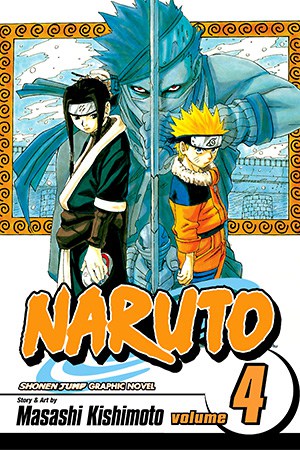
Iruka sees Naruto before the village does
Naruto’s graduation crisis turns on a quiet question: what changes when someone finally sees the child behind the pranks? The first chapter makes Iruka’s recognition feel earned, limited, and consequential.

Coverage: Covers the first chapter only, including Naruto’s graduation test and Iruka’s response; no later revelations.
A prank is a bid for an audience
Naruto’s opening mischief is noisy by design. He defaces the village’s monumental faces, gets caught, and is made to clean them. The scene gives him the attention he appears to want, but it also shows how little control he has over what that attention means. Adults see a nuisance to correct; Naruto has no easy way to turn their notice into regard.
That gap makes the pranks more than comic business. The village responds to Naruto as a disturbance before it responds to him as a child. His bright performance can command a crowd, but the crowd does not become a community. The first chapter’s humor therefore carries an ache: being visible is not the same as being known.
The classroom makes belonging conditional
Naruto’s failure to pass the graduation test gives that isolation an institutional form. The test is concrete, and his difficulty with the required technique makes the verdict seem objective. Yet the classroom also contains a social judgment: Naruto is already treated as the student whose antics and poor performance confirm what others expect of him.
Iruka’s position complicates that verdict. He is Naruto’s teacher and has to assess the same failure the class can see, but his own history of loss makes him alert to the difference between a child’s conduct and the need underneath it. His sympathy does not erase the rules or make Naruto pass. It gives the failure a human witness, which is a smaller but more credible change.
Iruka recognizes the child without excusing the act
Mizuki offers Naruto a different kind of attention. He presents himself as an ally and gives Naruto a path to the recognition he craves, but that apparent kindness is instrumental. Iruka’s care is less flattering: he challenges Naruto, responds to what he does, and still places himself between the boy and danger. The contrast asks readers to judge recognition by what it asks of the person receiving it.
When Iruka acknowledges Naruto, the moment matters because it is specific. He does not pretend the pranks were harmless or the test easy. He sees the lonely child beneath the disruption and treats that child as worth protecting. This is not the village’s collective acceptance, and the chapter does not suggest that one adult’s compassion can repair a whole social order. Its force comes from being honest about its scale.
A headband marks a beginning, not a cure
Naruto’s graduation is a changed status made visible, but the headband matters for a reason more intimate than certification. Iruka gives him the one he has been wearing. The teacher does not merely announce that a requirement has been met; he places something of his own into the relationship. That gesture follows Naruto’s successful use of the Multiple Shadow Clone Technique, so recognition and demonstrated ability arrive together. His earlier failure has not become meaningless, but it no longer supplies the only available account of what he can do. For a boy who began by forcing the village to look at him, receiving the headband offers a different experience: someone has already been paying attention. Iruka is willing to mark that attention with a tangible act.
That modesty gives the opening its emotional clarity. Naruto’s first success is not a triumph over everyone who dismissed him, and it is not proof that his loneliness has ended. It is the experience of one person understanding that his need for attention is also a need for connection. Iruka’s recognition gives Naruto a reason to imagine belonging, and the chapter ends by making that first reason feel enough to begin with.
Primary work & further reading
Primary work: Naruto. Character and story readings are editorial interpretations. The publisher reference below identifies the work and its premise.