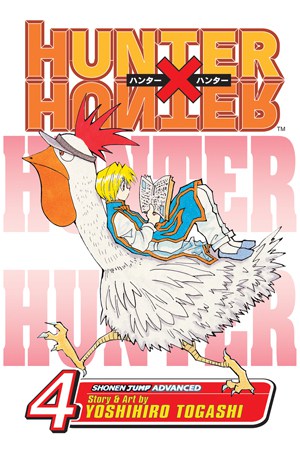
Gon's openness can be a difficult kind of determination
Gon’s departure from Whale Island looks like a simple adventure beginning, but his confidence has a demanding edge. The early Hunter Exam shows how his openness helps him connect with others while exposing him to consequences he cannot yet read.

Coverage: Manga material from Gon’s departure from Whale Island through the early Hunter Exam; no later arcs or outcomes.
Leaving home means choosing uncertainty
Gon’s decision to leave Whale Island begins with a question that is personal before it is heroic: why would his father choose the life of a Hunter over raising him? Mito has given him a home and a practical reason to stay, but the island’s routines cannot answer that question. The departure therefore feels less like rejection of family than an effort to understand an absence. Gon makes the choice with unusual certainty, yet the certainty does not mean he knows what he will find.
That distinction gives his determination its particular texture. Gon is not setting out with a theory about his father or a plan for how to become an adult. He has a direction, and he trusts that experience will supply the rest. His openness lets him move toward what he does not understand without disguising the uncertainty. It also makes the journey difficult: when he commits himself, he cannot rely on a detailed map of the consequences.
The natural world teaches attention
Before the exam turns his journey into a contest, the island’s fishing test presents Gon’s strengths as habits of attention. His attempt to catch the enormous fish his father once caught requires patience, strength and an understanding of the water. He does not win by insisting that the fish should yield. He watches, waits and acts at the moment the situation permits. The achievement connects his independence to a community: Mito’s approval matters because she knows what the test means.
That scene also complicates the idea that Gon is simply impulsive. His instinct can be quick, but he is capable of sustained concentration when a task becomes meaningful to him. He treats animals and landscapes as presences to engage with, not props in a personal quest. Whale Island has taught him that the world can be approached directly, through observation and response. The exam will challenge that approach by placing him among people whose motives are harder to read.
The exam tests more than endurance
The opening stages of the Hunter Exam turn movement into a test of judgment. Gon runs alongside the other applicants through long, exhausting stretches, but he also notices things that faster or more self-absorbed candidates overlook. His attention to the old woman’s question and the danger around the applicants reflects a willingness to stop and respond, even when the group’s momentum points elsewhere. The exam makes that decency costly by putting it in tension with survival and progress.
Gon’s response is not a polished ethical code. He does not pause to calculate whether compassion will improve his odds or establish a reputation. He takes another person seriously because that is how he meets the world. This makes him an appealing companion, but it also leaves him exposed to manipulation and to situations where good intentions are insufficient. The test’s severity shows that endurance is not just the ability to keep moving; it is the ability to choose what deserves attention while moving.
Openness can become a demand
Gon’s confidence is easiest to mistake for uncomplicated optimism. He enjoys challenges and is eager to meet people, but his open approach carries an insistence: he wants to encounter things for himself, even when someone older or more cautious would prefer to decide what is safe. That independence can unsettle the people who care for him. Mito’s worry is not proof that Gon is wrong to leave; it is evidence that his freedom has a cost beyond his own risk.
The early journey makes this tension productive rather than resolving it. Gon’s openness draws him toward fellow applicants and helps him notice needs that the exam’s competitive structure would obscure. At the same time, he must learn that encountering a person honestly does not guarantee that he understands them. His determination is difficult because it asks both him and those around him to accept uncertainty. By leaving Whale Island, Gon chooses a life in which attention, courage and judgment will have to grow together.
Primary work & further reading
Primary work: Hunter x Hunter. Character and story readings are editorial interpretations. The publisher reference below identifies the work and its premise.