Fire Emblem: Three Houses: make Sunday’s Activity Points answer a plan
A practical monastery guide to choosing a few high-value Sunday activities in Fire Emblem: Three Houses, then leaving enough room for changing student needs instead of spending every point by habit.
Coverage: Spoiler-light; discusses monastery and calendar systems without route or story outcomes.
A free day is a budget with competing purposes
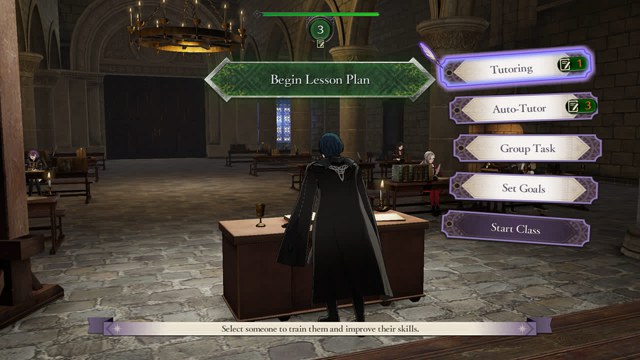
Fire Emblem: Three Houses divides life at Garreg Mach between instruction, relationships, and preparation for battles. Nintendo’s overview describes Sundays as time for activities around the monastery and notes that most, but not all, tasks consume limited Activity Points. Its beginner guide separately recommends checking the battle map, equipment, unit roster, and shop before a mission. The two pages point toward a useful habit: spend the free day on a defined need, while keeping the next battle in view. [1] [2]
The trap is treating every available activity as an obligation. A meal, choir practice, tournament, side quest, and conversation can all sound worthwhile, but the point of a limited budget is that selection matters. Choose the activity that answers the most immediate question for your class: morale, a recruitment opportunity, a skill gap, or a battle-specific weakness.
Name the next obstacle before you pick an activity
Before choosing, glance at the upcoming mission and identify one concrete concern. Are several students low on motivation for the next instruction cycle? Is a unit close to a class requirement? Does the map suggest a need for more reliable ranged support or a sturdier front line? Nintendo’s beginner guide recommends reviewing weapon condition, unit selection, terrain, enemy range, and the forecast before combat. Those checks can turn a broad “prepare more” impulse into a specific Sunday decision. [2]
For instance, if the likely issue is an underprepared unit, spending points on a morale-building activity may support more focused instruction later. If the army already has a sound shape but lacks supplies, the marketplace may better answer the immediate need. Treat this as a priority choice, not a guarantee that one activity directly fixes every downstream problem: the value comes from aligning limited time with what you intend to do next.
Use one activity to support people, another to support the plan
A monastery day feels richer when it serves more than a spreadsheet. Nintendo’s overview describes meals, exploration, choir practice, side quests, and conversations as ways to spend time with students or develop the professor. Pick a relationship-oriented action when it also helps you understand a student or sustain motivation; pick a training or market option when it addresses a clear tactical gap. This gives each point a reason without reducing the monastery to an optimization screen. [1]
If you have a favorite student you want to recruit, let that goal shape the day, but do not assume every activity is interchangeable. Some opportunities depend on the calendar, a unit’s abilities, or a particular encounter. The game’s calendar signals noteworthy events, while its activity system asks you to choose among finite actions. Check the available options as they appear and spend on the one that advances a real goal, rather than following a fixed rotation that may not fit this week.
Spend on the strongest priorities first
When several activities compete for a limited pool, order them by how directly they answer the need you named. Put a scarce or time-sensitive opportunity ahead of a pleasant but optional one; if a battle concern is already addressed, shift to a student or relationship goal. This is a sequencing habit, not a claim that points carry over: it protects the most useful choices from being crowded out by low-priority clicks.
A short Sunday checklist
Try this sequence: check the calendar, inspect the next battle’s map and forecast, name one weakness to address, choose one activity that supports a student or class goal, and reassess before using the remaining points. Then use the battle preparation screen to verify weapons, units, and supplies before departure. Nintendo explicitly recommends that final pre-battle check and explains that terrain and enemy ranges are visible on the map. A Sunday plan is useful when it ends in a clearer decision on the battlefield, not when it empties every counter. [2]
There is no single best Sunday for every route or roster. The steady principle is narrower: let the upcoming challenge choose the day’s priority, and let the people at Garreg Mach remain part of the reason you care about that challenge.
Primary work & further reading
Primary work: Fire Emblem: Three Houses. Character and story readings are editorial interpretations. The publisher reference below identifies the work and its premise.