Garreg Mach makes teaching part of strategy
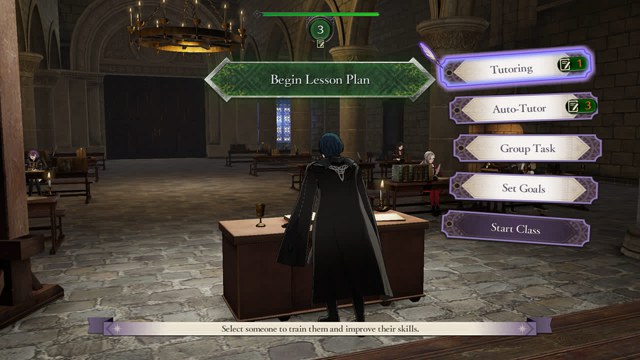
In the academy phase, instruction spends motivation, meals can replenish it, and weekly goals develop skills on a separate track. Planning around those systems—and knowing that a certification needs both a seal and skill readiness—helps you prepare students without treating every free day as the same kind of action.
Coverage: Covers academy-phase instruction, motivation, weekly goals, certifications, and free-day choices; avoids time-skip, route, and later story spoilers.
Spend free days on the need in front of you
A free day offers a choice among activities such as exploring the monastery, battling, attending a seminar, or resting. These are alternatives for that action slot, so you cannot do all of them on the same free day. Pick based on the problem you want to solve: a battle gives the group a chance to fight, a seminar develops skills for its attendees, and exploration lets you handle monastery activities and prepare for instruction. Rest is another option when you want to recover rather than pursue one of those activities.
That choice matters because direct instruction draws on a student's motivation. If you plan to instruct several students, first check who has motivation available and who most needs your attention. For example, if two students from your own house need motivation, you could explore and share a meal with them before the next instruction session. The meal spends professor activity points, but it can restore motivation, making those students better prepared to receive instruction. It uses resources and time you could have spent elsewhere, so reserve it for students whose training is a priority.
Use weekly goals alongside personal instruction
Weekly goals and individual instruction do different jobs. A goal gives a student a skill or area to train over the week; it is not the same as a personal lesson from the professor. Individual instruction lets you direct attention to a particular student and skill, while the weekly goal continues developing its chosen area separately. Treat the goal as steady background training and save direct instruction for a specific gap or a skill you want to emphasize.
Sylvain offers a clear planning example: his interest in lances and riding points toward a mounted lance role. You can set a relevant weekly goal and use instruction to support a skill that needs more attention. Lysithea's interest in Reason magic suggests a different direction, with magical development as the focus. These are useful starting points, not guarantees about the best class or a promise that either student is available in every house. Recruitment and class access differ by house, so plan around the students you actually have.
Treat certification as a check, not an automatic promotion
Training a skill does not automatically change a student's class. To attempt a certification, you need the appropriate seal, and the student must have enough readiness in the required skills for a chance to pass. Instruction can improve readiness, but it does not itself grant the class. Before spending a seal, check the certification requirements and the student's current proficiencies; a student who still needs development may be better served by another week of goals or instruction.
This makes class planning a sequence of decisions instead of a single long-range order. If you want Sylvain to pursue a mounted role, for instance, you can train lance and riding, then check his certification options when you have a seal. The tradeoff is that directing time toward those skills leaves less attention for other proficiencies. Lysithea's Reason focus leads to a different set of priorities. Neither route has a universal exact threshold to memorize here: the practical step is to inspect the requirements shown in your own game and attempt certification when the skills and seal are in place.
Make the calendar support your roster
A useful routine begins with the roster and works backward. Identify which students need direct instruction, which can keep progressing through weekly goals, and whether a meal would restore motivation for a priority student. Then choose a free-day activity that fits: explore to manage meals and monastery tasks, attend a seminar for skill development, battle when you want a fight, or rest. Because each free day is a choice among activities, trying to cover every need at once will leave some for a later week.
The payoff is a house prepared through several connected systems rather than one repeated action. A student can train a weekly goal while motivation is saved for instruction; a meal can restore some of that motivation at the cost of professor activity points; and certification remains a separate step requiring a seal and skill readiness. Keep checking what your students can access and what the next class demands. That turns Garreg Mach's calendar into a practical planning tool for the battles ahead, without assuming every student follows the same path.
Primary work & further reading
Primary work: Fire Emblem: Three Houses. Character and story readings are editorial interpretations. The publisher reference below identifies the work and its premise.