Fuka's Prinny cap and the comedy of refusing reality
Fuka insists that Hades is a dream even as her Prinny outfit places her among its condemned souls. Beside Desco, whose fantasy is to become a final boss, she turns denial into the beginning of an unlikely family.

Coverage: Covers Fuka’s death denial, Prinny identity, and early bond with Desco; no ending events.
The costume makes denial visible
Fuka is a middle schooler who has died, but she does not accept that fact. She believes her stay in Hades is a dream, and her confidence in that explanation persists despite the prison setting around her. The Prinny hat and jacket make the contradiction visible. Prinnies are the burdened souls of humans sent to Hades, yet Fuka wears the signs of that identity while refusing its meaning.
That visual joke is more precise than simple obliviousness. The outfit places Fuka inside the world she says cannot be real, so every appearance lets the story hold belief and evidence in the same frame. Her positive mood gives the denial a buoyant quality, but it also shows how she protects her sense of herself. She can inhabit Hades without allowing its explanation of her life to become the only explanation she has.
A fantasy can be both comic and protective
Fuka’s refusal is funny because the audience can see the mismatch she cannot—or will not—acknowledge. The comedy comes from her readiness to explain away a place built around death as a dream. But the premise also gives that refusal emotional weight. She cannot recall committing a crime, and the identity assigned to her by Hades does not feel like an answer she can make her own. Calling the situation a dream keeps some control in her hands.
The story does not need to treat that coping strategy as wisdom to make it meaningful. Fuka’s outlook can be wrong about the facts and still matter as a way of meeting an unfamiliar world. Her cheerful insistence changes the tone of the place around her; it makes the punitive logic of Hades share space with a schoolgirl’s ordinary self-conception. The cap is funny because it is so conspicuous, but it also marks the distance between what the system says Fuka is and what she is willing to believe.
Desco’s ambition supplies a different script
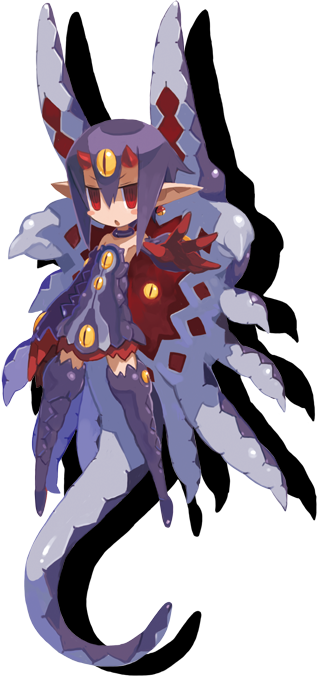
Desco is built around another extravagant idea of identity. Her official designation describes a final weapon, and she believes she was born to become the Final Boss. Imprisoned in Hades before she could fulfill that purpose, she meets Fuka and begins calling her “Big Sis.” The relationship joins two characters who both approach reality through scripts, though the scripts point in opposite directions.
Fuka’s fantasy shrinks the significance of her circumstances: Hades is only a dream. Desco’s expands her significance: she is destined for a grand role at the center of a climactic conflict. One refuses the world’s account of her past; the other imagines a future that gives her a purpose. Their pairing makes room for both forms of play without making them identical. Fuka offers warmth and a familial place, while Desco brings an eager, theatrical sense of destiny.
A family forms before either fantasy ends
Desco’s use of “Big Sis” turns a grand ambition into an intimate request. She may imagine herself as a final boss, but she also wants a relationship that is not defined by her weaponized purpose. Fuka, in turn, is treated as a person to join rather than as a Prinny-shaped case to be explained. Their attachment develops inside the absurdity of the premise, yet it gives both characters a more immediate role than the fantasies that first organize them.
That is why their bond need not depend on either girl admitting the full truth of her situation or achieving her imagined destiny. The comedy of refusal becomes a way to approach one another: Fuka can keep insisting on her dream, and Desco can keep dreaming of her final-boss future, while “Big Sis” names a present connection. Together, they suggest that a family can begin in the space between a person’s assigned identity and the story she tells herself.
Primary work & further reading
Primary work: Disgaea 4. Character and story readings are editorial interpretations. The publisher reference below identifies the work and its premise.