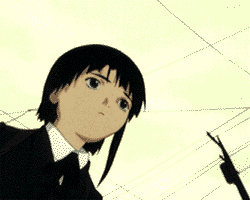
FLCL's style changes follow the pressure of a scene
FLCL’s visual shifts feel less like decoration than a way to register changing emotional pressure. Its manga-like images, abrupt changes in animation, and music-led rhythms give scenes permission to move between comedy, unease, and impact.

Coverage: Discusses the original six-episode series’ visual and musical approach without describing its finale resolution.
A frame can change the rules
The original FLCL does not ask its images to obey one steady visual register. A scene can move through familiar animation and then lean into a manga-like image, a flattened pose, or a sudden graphic interruption. The shift asks the viewer to notice how a moment feels, not just what happened in it. An image may compress a reaction into a bold sign, giving an emotion the force of a printed panel even while the story continues to move.
That flexibility suits a series built around a boy trying to treat the extraordinary as if it were beneath his notice. A conventional, settled image can support the town’s routine; a striking change in presentation can expose how little control Naota has over the moment. Because the shift is abrupt, it does not feel like a decorative label attached to a scene. It changes the viewer’s footing. We are made to register that the story’s tone, and sometimes its sense of reality, has just been pushed somewhere else.
Abrupt animation makes impact legible
The series also changes its animation approach from moment to moment. Broad, elastic motion can make a gag feel physically impossible, while a more restrained passage lets a character’s posture or expression carry the weight. These variations create a contrast between movement that overwhelms the frame and movement that seems to hold back. The comedy becomes more forceful when the surrounding scene has established a recognizable rhythm before it breaks.
This unevenness can make a character’s reaction more revealing than the event itself. A sudden visual exaggeration might show how an intrusion fills Naota’s world, while a quieter image gives space to the awkwardness he cannot easily say aloud. The point is not that every change maps neatly to a single emotion. Rather, the shifts keep the scene responsive: animation can expand to match an impact, then contract when the story needs a pause. The style becomes a way to regulate attention, deciding when a moment should rush at us and when it should leave us with a face.
Music turns a cut into momentum
Music helps shape those changes by giving scenes a pulse that can carry across images. The use of songs by the Pillows gives the series an energetic musical texture, and that texture can make transitions feel less like neat punctuation than a surge into the next beat. Images and sound do not always settle into a calm explanatory relationship. Instead, a track can propel a sequence, making movement feel driven by rhythm even when the story’s events remain strange or disjointed.
That propulsion also creates an unusual kind of emotional distance. A song can make a scene exhilarating, but its momentum may keep the viewer from pausing to treat every action as solemn. Humor and intensity can coexist because the music carries a feeling of urgency without demanding a single interpretation. The result is not simply an illustrated soundtrack. Rhythm helps organize the viewer’s experience: it tells us when an awkward event has become kinetic, when a collision should feel like a release, and when the scene’s energy has outpaced the characters’ ability to explain it.
Style follows pressure, not polish
Taken together, the shifts in drawing, movement, and music make FLCL’s style feel tied to pressure. A scene may be quiet until a person barges in, then jump to images and rhythms that make the interruption feel larger than the room. Another moment can let that excess fall away, bringing attention back to a character’s hesitation. The changes are not a promise that the series will use the same visual trick every time. Their value lies in keeping the form sensitive to the moment’s force.
That is why the style can feel both unruly and deliberate. It permits mismatched tones because the characters themselves are trying to inhabit experiences that do not arrive in tidy categories: embarrassment can sit beside excitement, and domestic routine beside sudden absurdity. FLCL’s visual freedom gives those collisions room to register without forcing them into a consistent, polished surface. The shifts do interpretive work. They make the viewer feel when a scene has become too crowded, too fast, or newly exposed, and they return the story to ordinary scale when that pressure recedes.
Primary work & further reading
Primary work: FLCL. Character and story readings are editorial interpretations. The publisher reference below identifies the work and its premise.