Fire Emblem: Three Houses certifications reward a plan with room to bend
A practical way to read goals, skill requirements, and exam odds in Fire Emblem: Three Houses without forcing every student down the same class path.
Coverage: Spoiler-light: discusses academy instruction and class certification, without route or late-story revelations.
A certification is a checkpoint, not a command
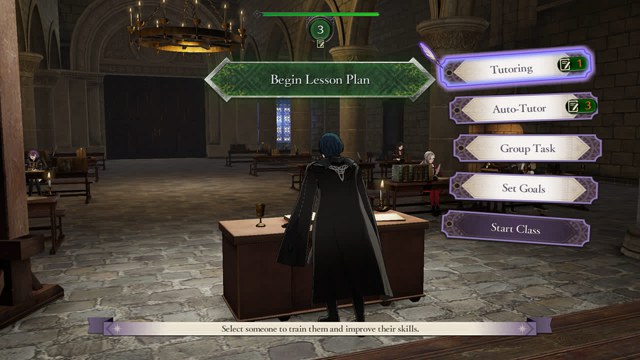
Three Houses turns class progression into a set of requirements that can be planned toward, but the certification screen is not a demand to change classes immediately. Nintendo’s beginner guide describes goals as the skills students study during the week and explains that certifications test whether a unit has reached the relevant skill grade. The game overview likewise frames the professor’s role as classroom instruction joined to battlefield leadership. Read together, those systems make a certification a planning checkpoint: it tells you what a student can attempt and what a different class could offer, while leaving the actual role decision to you. [1] [2]
That distinction helps prevent a common menu trap. A highlighted exam can feel like a to-do item, especially when a student has reached the listed level. But a class is a tool for a particular job in your squad. Before paying attention to the exam percentage, ask what you need that unit to do on the next map. If the answer is already clear, the class path has a purpose. If not, more training may be less useful than a look at the roster and battlefield together.
Start with the job, then inspect its requirements
Choose a practical role before selecting a row of skills to raise. A unit who needs to reach distant enemies, hold a narrow approach, or support allies at range may call for different class directions. Nintendo’s guide notes that classes shape attacks, movement, and stats, and that the certification requirements vary with the class. That makes “which skill is highest?” a weaker starting question than “what battlefield problem should this student solve?” Work backward from the role you want and check which grade or level is still missing. [1]
Then compare the required training with what the student already does well. Their starting proficiencies and goals are a useful baseline, not a binding script. If the desired role asks for a skill that the student is already studying, the route may fit naturally. If it asks for a stretch, decide whether the payoff matters enough to spend weeks pursuing it. You do not need every unit to be a specialist in the same set of weapons; a class plan is strongest when it fills a need the rest of the team cannot cover as conveniently.
Use the calendar as a review rhythm
The weekly routine gives you repeated chances to check whether a plan still makes sense. Nintendo describes instruction and goals as part of the academy calendar, with study experience accumulating over the week, while days off allow exploration, battles, seminars, rest, and certification attempts. Rather than setting a long-term target and ignoring it, make a short review at each new month: inspect the next mission, see which skill has advanced, and decide whether the intended class still answers a real need. [1]
This turns instruction into a flexible schedule instead of a grind checklist. If the next mission rewards mobility, you may keep focusing on the skill that supports that role. If your roster is already comfortable in that area, you can redirect attention toward a gap. The useful question is not “Did everyone level the same amount?” but “Will the next set of choices give me options when the map asks for something different?” The system’s calendar makes that reassessment part of play, not wasted preparation.
A worked planning example
Imagine a student you want to use as a mounted attacker. Treat this as a planning exercise, not a prescribed build: inspect the class requirement, compare it with the student’s current skill grades and goals, and note the distance between them. If the required skill is progressing naturally, keep that goal and revisit the exam when the grade improves. If it is far behind, ask whether the role is essential now or whether another available class can cover the upcoming map more reliably. The example is about choosing a route, not proving one unit is universally best.
Next, weigh exam odds against timing. Nintendo’s guide says a student who meets the required grade has a 100% success rate, while a student below it may still attempt the exam at a lower chance. That means a risky early attempt is a choice with uncertainty, not a guaranteed preview. If the class would solve an immediate roster problem, a lower chance might be worth considering; if the current class remains useful, waiting for more training preserves the option without turning every attempt into a gamble. [1]
Keep a second route available
A class plan should leave room for what the game actually puts in front of you. The official overview emphasizes that the story branches according to the house you teach, and the beginner guide describes battles as places where units’ class-dependent movement and attacks matter. Those facts support a modest habit: check the next objective and roster before committing scarce instruction to a distant ideal. You can still pursue a preferred class, but do so with a fallback role in mind. [2] [1]
The result is a plan with a destination and a detour. Pick the battlefield function, identify the skill requirement, use each month’s calendar to measure progress, and keep the current class in view until the new option is ready. Certification then becomes what the menu says it is: an opportunity to qualify for another role. Your team, rather than the exam list, decides whether taking it is the right next move.
Primary work & further reading
Primary work: Fire Emblem: Three Houses. Character and story readings are editorial interpretations. The publisher reference below identifies the work and its premise.