Pochita makes the opening contract an act of companionship
Pochita begins as Denji’s devil partner and working companion, but their bond is built from shared hardship as much as supernatural power. In the opening chapter, the contract reads as a promise between two beings who have learned to depend on each other.
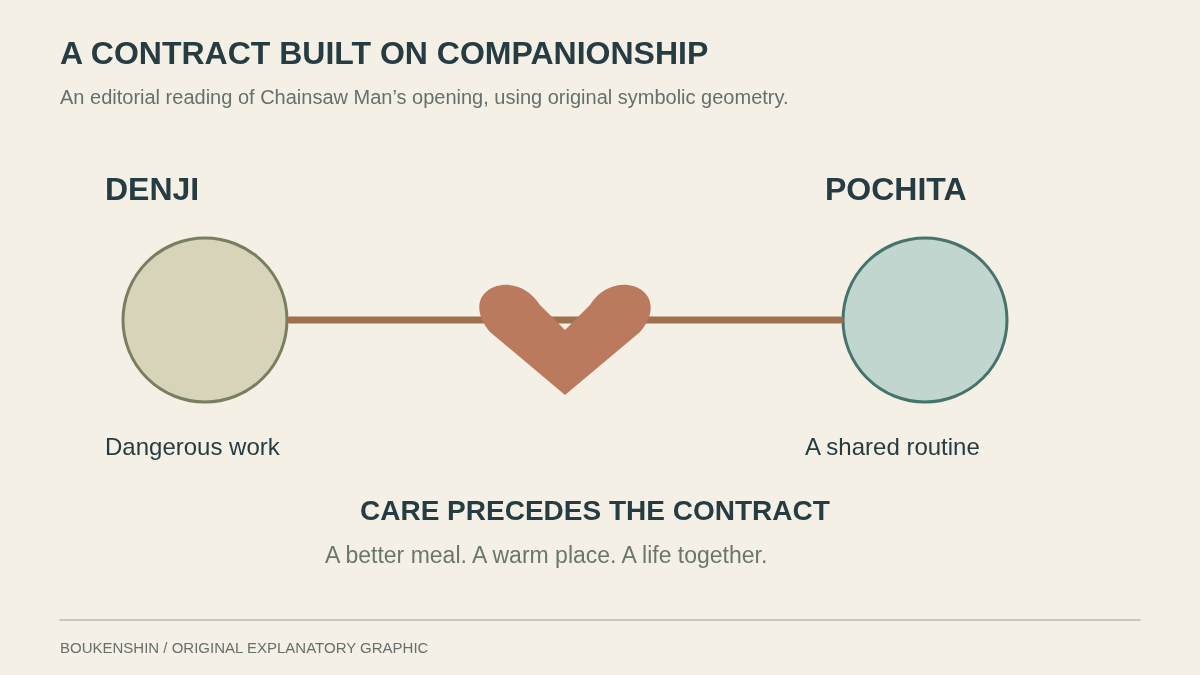
Coverage: Opening chapter only; covers Denji and Pochita’s work, bond, and contract, without later cosmology.
A partner before a power
Pochita enters the opening as a devil, but Denji’s treatment of him makes the category feel incomplete. He is also a small companion who follows Denji through a life of dangerous work. The bond is visible in practical dependence: Denji hunts devils with Pochita at his side, and the two share the consequences of a job that offers little security. Their relationship has no comfortable domestic backdrop. Companionship takes shape inside labor, with each relying on the other to keep moving.
That shared work changes the emotional weight of the partnership. Pochita is not introduced as a weapon Denji has acquired and can simply use. He is an individual presence in Denji’s already narrow world, one with whom he can share small hopes. The opening’s pairing of devil hunting with familiar affection invites a reader to hold both facts at once. The supernatural premise may make Pochita dangerous, but the story first lets his closeness to Denji make him important.
Work binds them to a harsh routine
The jobs Denji takes are not framed as a thrilling career. They are a way to meet the burden of inherited debt, and Pochita is part of the means by which Denji attempts to do so. This puts the partnership under pressure from the start: affection exists alongside the need to earn. The two do not get to choose an easy adventure together. Their shared routine is shaped by an economic trap that treats danger as one of the few available forms of work.
Yet the story does not reduce Pochita to equipment in that routine. The distinction between working together and being used matters because Denji’s life has so few relationships beyond obligation. Pochita’s presence offers a kind of mutuality: they face jobs as a pair, and the opening gives their closeness emotional room even while the work remains grim. Their bond does not erase the conditions around them. It gives Denji someone with whom those conditions can be endured and a dream that can be shared.
A shared dream gives the bond its tenderness
Denji’s dream of simple comforts is bound up with Pochita’s companionship. The imagined pleasures are not only a checklist of possessions; they point toward a life in which both can experience ease. In a story that begins with Denji’s hunger and debt, the idea of sharing a better future makes the wish less solitary. Pochita is not merely present for the work that keeps Denji alive. He belongs in the picture Denji makes of what life could become.
The dream’s ordinariness strengthens that tenderness. Neither character needs a grand promise to make their connection matter. The possibility of a meal, warmth, or a gentler daily existence carries force because they have so little. This also makes Pochita’s companionship distinct from a contract based only on exchange. The opening lets care precede the formal bargain: the pair already share work and hope before the story asks what a contract between them might demand.
The contract as a promise between companions
When the opening reaches its contract, the event is prepared by the relationship that already exists. A contract might suggest a cold bargain between entities with separate interests, but here it emerges from a bond shaped by loyalty and a common dream. The terms carry supernatural consequence, yet their emotional force comes from familiarity. Pochita is not an unknown power arriving to rescue Denji; he is the companion who has been beside him through the life that made rescue necessary.
Reading the contract as companionship keeps its meaning intimate. It does not turn their hardship into a sentimental adventure or make the danger disappear. Rather, it shows how the opening’s central relationship gives Denji’s survival a human scale. The devil and the boy have worked together, relied on one another, and imagined something better. The contract makes that connection decisive, turning shared hope into an act of commitment. In the opening chapter, Pochita matters because power and affection arrive through the same bond.
Primary work & further reading
Primary work: Chainsaw Man. Character and story readings are editorial interpretations. The publisher reference below identifies the work and its premise.