Baccano's chronology rewards recognition before explanation
The anime asks viewers to recognize people and events before their relationships become easy to place. Its shifting chronology turns familiarity into a form of orientation, making attention more useful than a demand for immediate order.
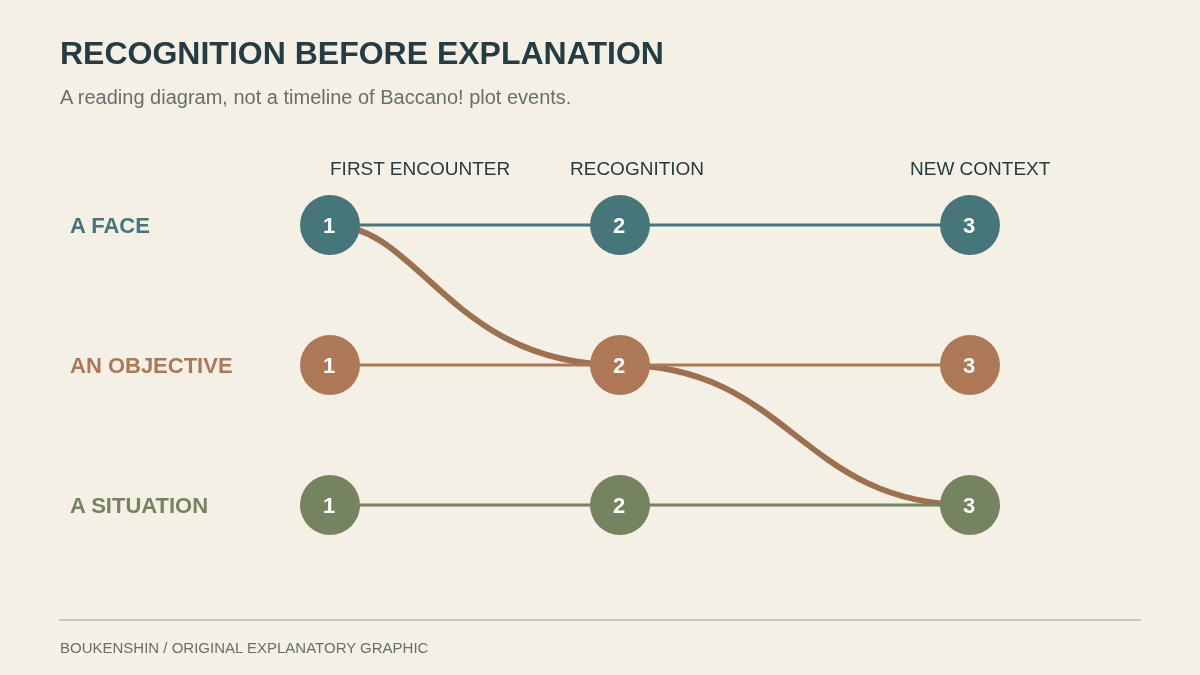
Coverage: Discusses the anime’s repeated scenes, crosscutting, and viewer orientation without supplying a full timeline solution or episode order.
Familiarity arrives out of order
Baccano! does not make chronological certainty the price of entry. It shifts among strands, placing characters and events before viewers have all the context needed to connect them. A face or situation may recur with a different emphasis, and what first looked like a stray detail can acquire new relevance through recognition. The anime’s basic demand is modest but unusual: keep noticing who is present and what kind of pressure they seem to be under, even when the larger arrangement is unclear.
This choice changes the experience of watching. In a straightforwardly ordered account, viewers can often lean on sequence: one event explains the next, and the meaning of a scene follows from what came before. Here, sequence offers less immediate help. Recognition takes on that work. The viewer begins to remember a character’s bearing, an ongoing objective, or the shape of a recurring situation before knowing exactly where it belongs. Familiarity becomes a provisional map, not a solved explanation.
Repetition turns into comparison
When an image or situation returns, the repetition invites comparison. What changes is not always the event itself; it may be the viewer’s sense of who has noticed it, what someone wants, or how much the scene matters to another strand. A second look can make the first feel less incomplete and more carefully limited. The anime is showing how a fragment can have one meaning inside its immediate context and another when placed beside material the viewer has encountered elsewhere.
That does not mean every return is a hidden clue with a single answer. Repetition can also establish mood and relationship, letting viewers feel the persistence of a conflict or the strange way different people occupy the same story. The distinction matters because it keeps the structure from becoming a mechanical scavenger hunt. Recognition is rewarding not only when it unlocks information, but when it sharpens an impression. A character who seemed incidental can gain weight through recurrence, even before the larger design is clear.
Crosscutting makes uncertainty active
The anime’s crosscutting keeps viewers from settling into one strand for long. A shift can move us from a tense encounter to comic behavior, or from one group’s immediate problem to another’s. The change may interrupt a simple question—what happens next?—but it prompts a more useful one: what kind of story is each group living through, and where might those stories touch? Because tones and objectives vary, viewers must carry more than one expectation at a time.
That kind of uncertainty has a rhythm. A scene supplies enough detail to make its people and stakes legible, then a cut asks us to hold that partial understanding while attention moves elsewhere. The viewer is not left without orientation; orientation simply depends on memory and contrast. The broad pattern becomes clearer as separate scenes begin to resonate. A detail from one strand can change the texture of another without making either strand merely an explanation for the other.
Attention before the answer
There is a difference between confusion and delayed arrangement. Confusion leaves the audience with nothing firm to hold; delayed arrangement gives them recognizable pieces while postponing their final placement. Baccano! leans on the second approach. Its characters have recognizable personalities and immediate concerns, even while the audience may not yet understand how their circumstances fit together. That grounding matters. It makes the shifting chronology feel like an invitation to observe rather than a test designed to punish anyone who misses a connection.
The structure finally rewards a kind of patience that is also active. Viewers learn to take each scene seriously on its own terms, while remaining open to its changing relation with other scenes. Recognition comes first because the anime wants the audience to experience connection as something discovered among people and moments, not delivered as a master diagram. Its chronology makes orientation an act of attention. The pleasure lies in feeling the ensemble become more legible while its individual lives retain their own force.
Primary work & further reading
Primary work: Baccano!. Character and story readings are editorial interpretations. The publisher reference below identifies the work and its premise.