Azumanga Daioh: Osaka takes the side door into a joke
A manga reading of Osaka’s comedy in Azumanga Daioh: her apparent distraction makes the familiar classroom setup pause long enough for an unexpected angle to become the punchline.
Coverage: Spoiler-light; discusses Osaka’s comic characterization without plot-ending details.
The joke begins with a mismatch in pace
Osaka’s comedy often depends on the gap between the pace a classroom expects and the pace she brings to it. Yen Press introduces her as “different,” a deliberately broad shorthand that leaves room for the reader to discover how that difference works in a scene. She may seem to drift away from the conversation’s immediate goal, but the detour is not empty: it changes what the group is paying attention to. [1]
That change is why her pauses can function as punchlines. A conventional gag often moves quickly from setup to correction: a character misunderstands something, another points it out, and the scene snaps back to normal. Osaka can hold the mistaken frame open for another beat. The other girls’ reactions become part of the joke, because they must decide whether to correct her, follow her thought, or simply let the moment pass.
A side thought can reorganize the panel
Azumanga Daioh’s four-panel form makes this timing visible. Each small unit has a boundary, so a thought that wanders can cross into the next panel and acquire a new meaning there. The reader sees both the original conversational track and Osaka’s alternate route. Instead of treating her as a machine for random non sequiturs, it is more useful to notice how her detour makes an ordinary object, phrase, or situation newly available for attention.
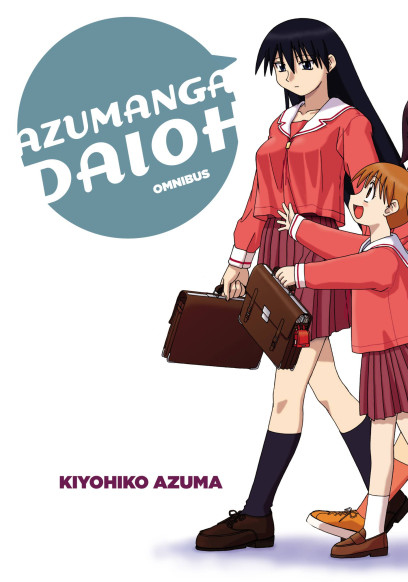
Yen Press’s edition gathers the series as a large omnibus, and its description emphasizes the ensemble rather than a single protagonist. That framing suits Osaka’s role: she is funny in relation to the rhythms around her. Her classmates supply the expected response that lets her unexpected response register. A blank look, a delayed answer, or a shift in focus can be as structurally important as the words themselves. [1]
“Different” does not mean disconnected
The publisher’s brief label is a useful entry point, but the manga’s humor is more precise than “Osaka is odd.” She remains part of the group even when she does not move through a conversation in the same way. The others know her well enough to respond without turning every difference into a crisis. The scene can return to shared life after her thought has briefly bent it sideways. [1]
That pattern keeps the humor affectionate without making every joke an endorsement of teasing. The comic target is often the gap between expectation and outcome, not a claim that Osaka is incapable of understanding people. When readers pause on the other characters’ reactions, they can see how a classroom maintains its social rhythm: attention is redirected, a misunderstanding is absorbed, and the group continues. The joke lives in that small negotiation.
Why the classroom can sustain a long-running joke
Yen Press notes that its edition collects all four volumes in an omnibus and describes the series as a school story centered on a group of girls. That collected format highlights how small recurring traits can gain force through repetition. One Osaka moment is a surprise; several moments teach the reader to expect that she may approach the same ordinary day from an oblique direction. The pattern becomes a character rhythm without requiring every scene to repeat the same gag. [2]
A useful way to read her scenes is to track three beats: what the group assumes will happen, what detail Osaka notices instead, and how the others adjust. This keeps the analysis grounded in the page rather than reducing the character to a label. The side door into the joke is also a way back into the ensemble: Osaka’s detours give her friends another chance to show how they know one another.
Primary work & further reading
Primary work: Azumanga Daioh. Character and story readings are editorial interpretations. The publisher reference below identifies the work and its premise.